Work-in-progress
Intensifying the Search
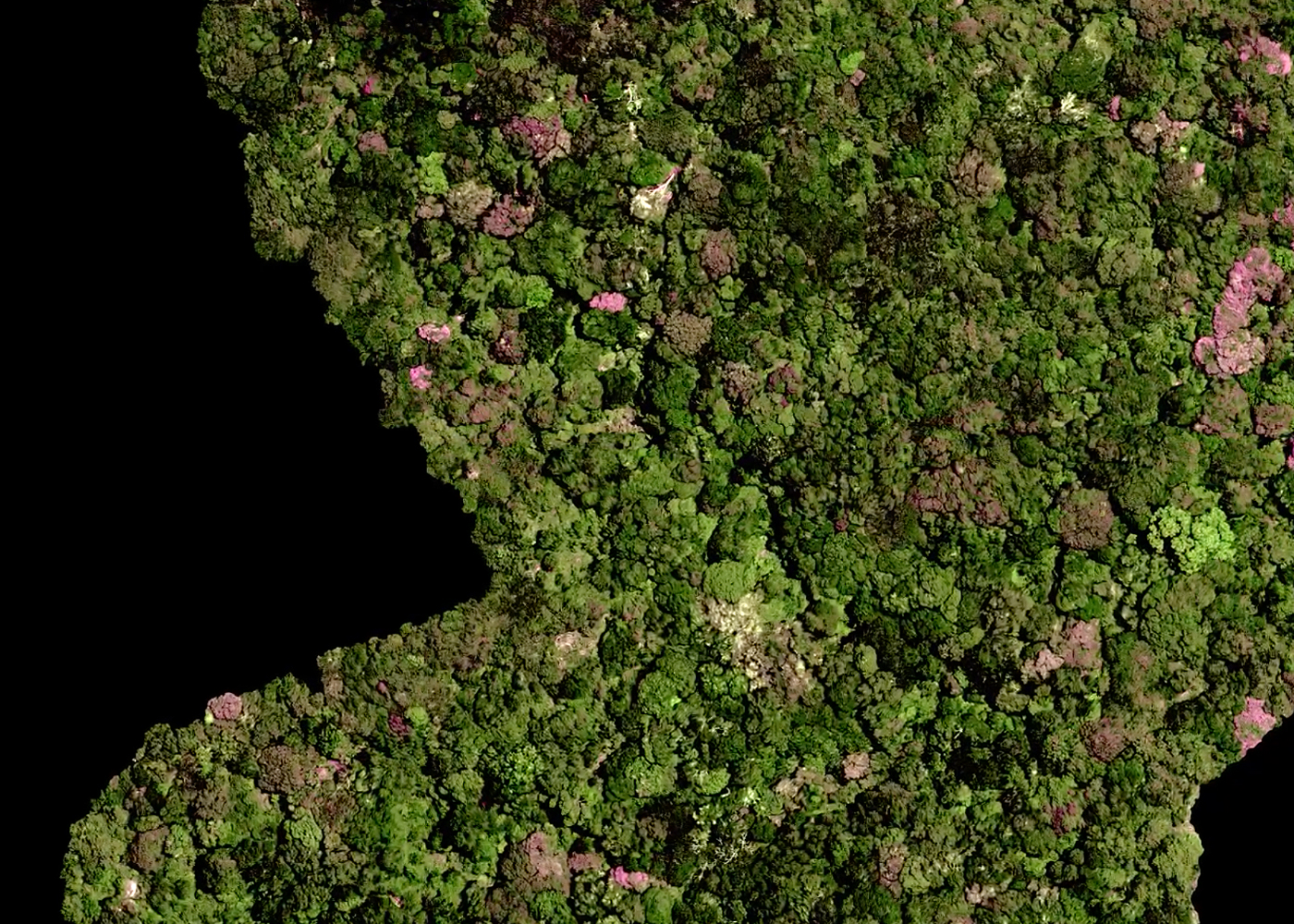
AI in the Sky builds from Living Dead: On the Trail of the Female (2022) that explored the use of drone aerial mapping to search for a female partner for one of the rarest plants in the world, the cycad - Encephalartos woodii (E. woodii). The survey focused on a very small portion of the forest and showed promising potential in using drone technology to locate rare and endangered species.
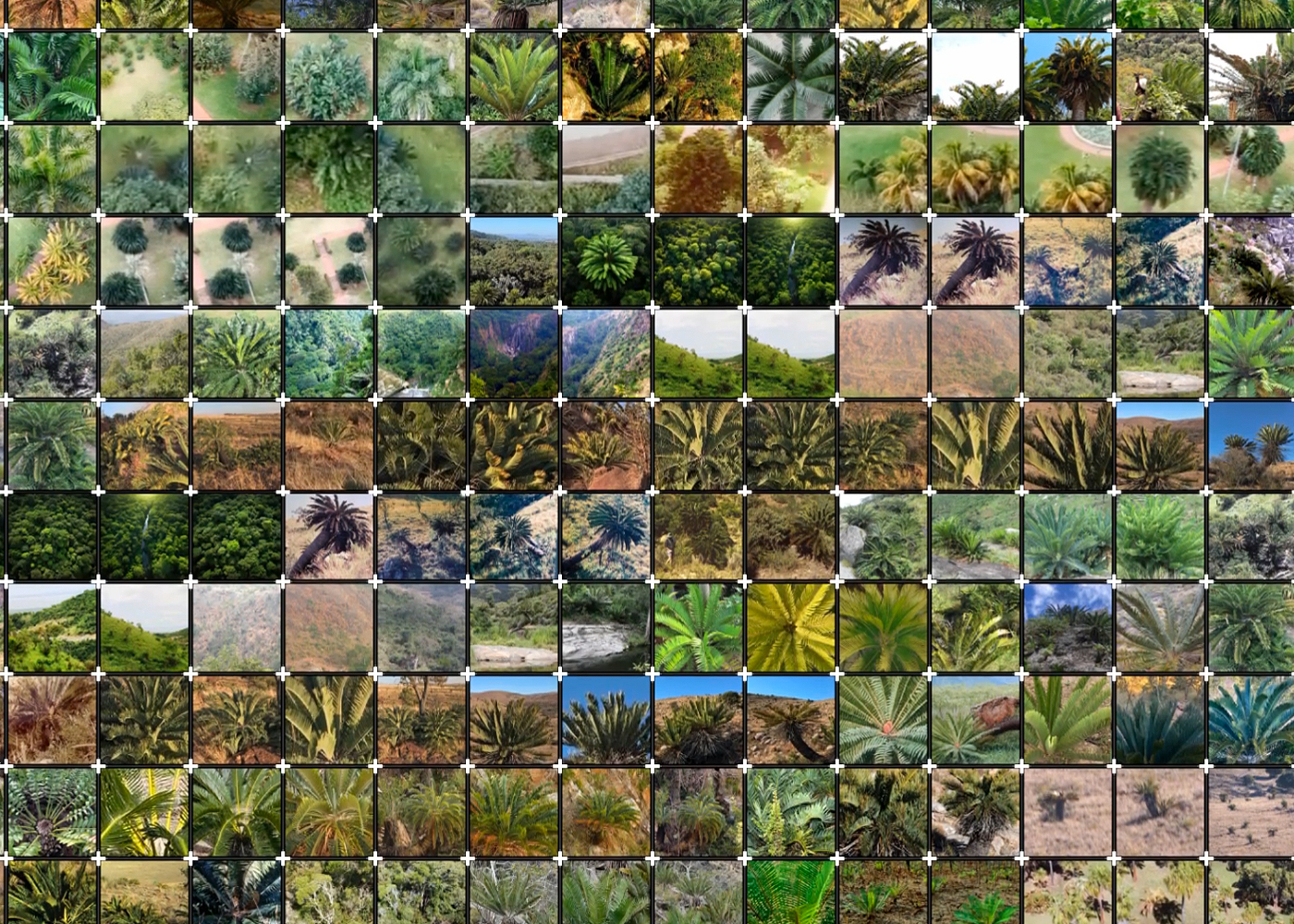
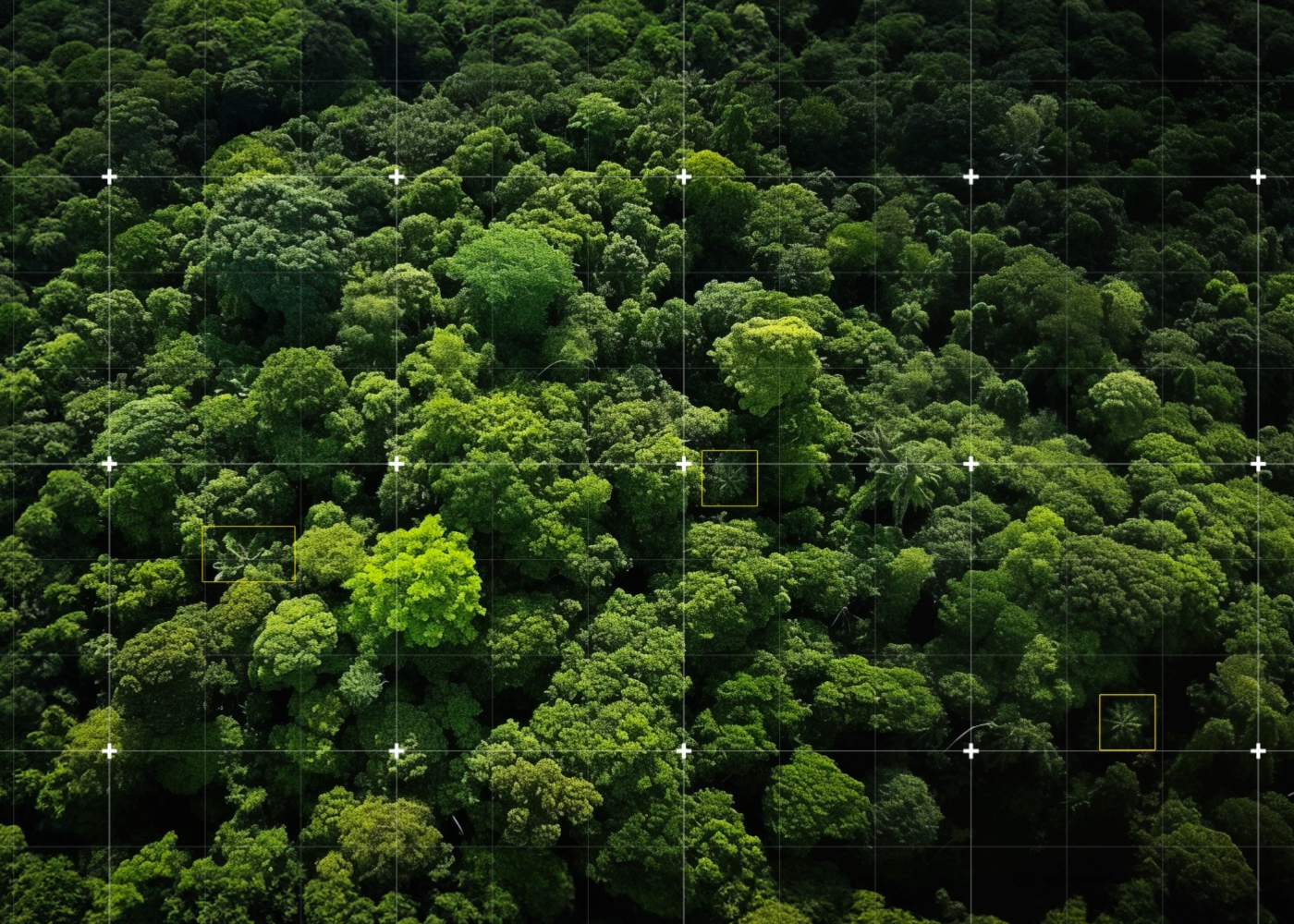
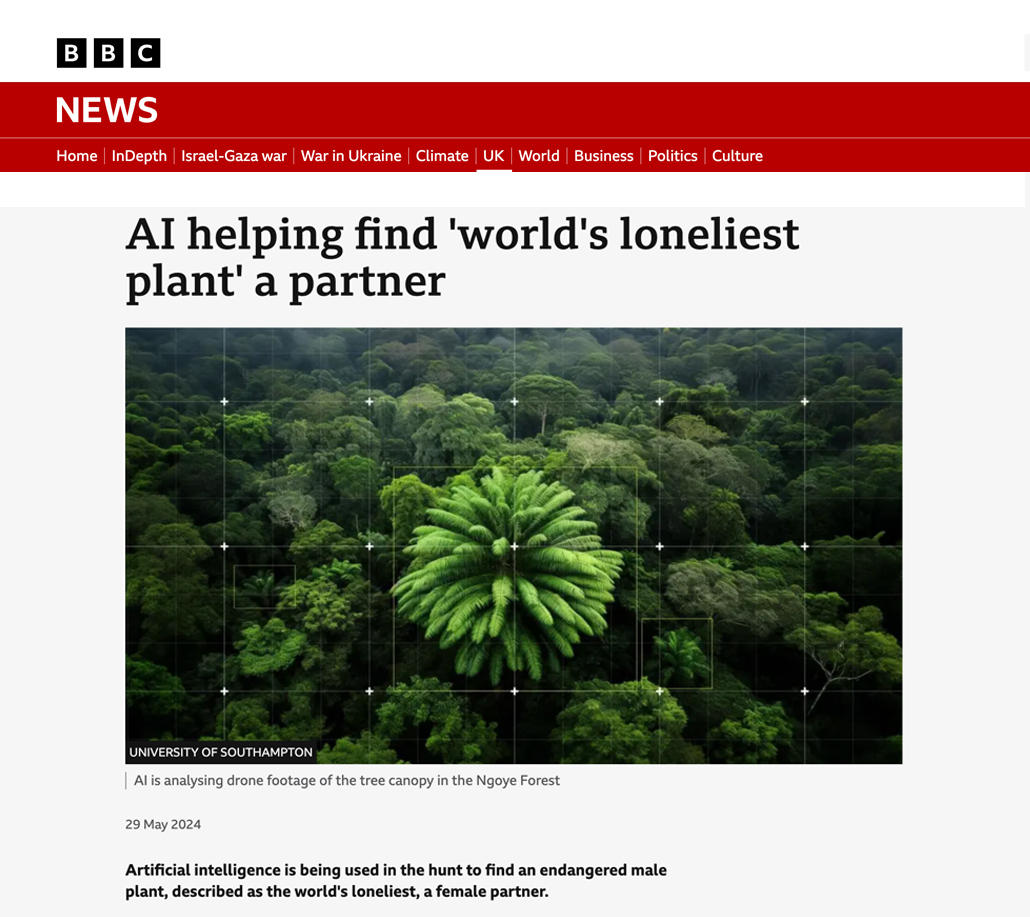
AI in the Sky expands the search area and uses machine learning analysis together with synthetic data to improve how the maps are searched. The synthetic images and data created using a generative model are used to create maps and visualisations of the cycad in the search area.
E. WOODII &
The Elusive Female
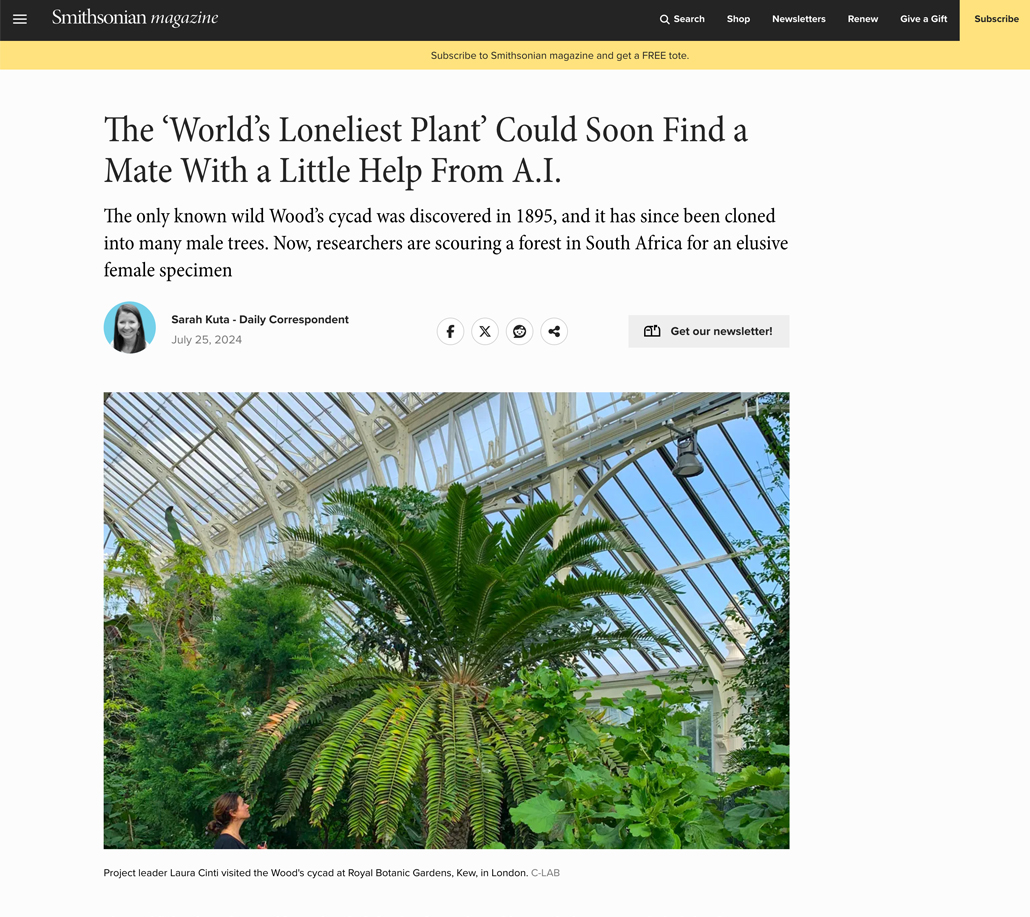
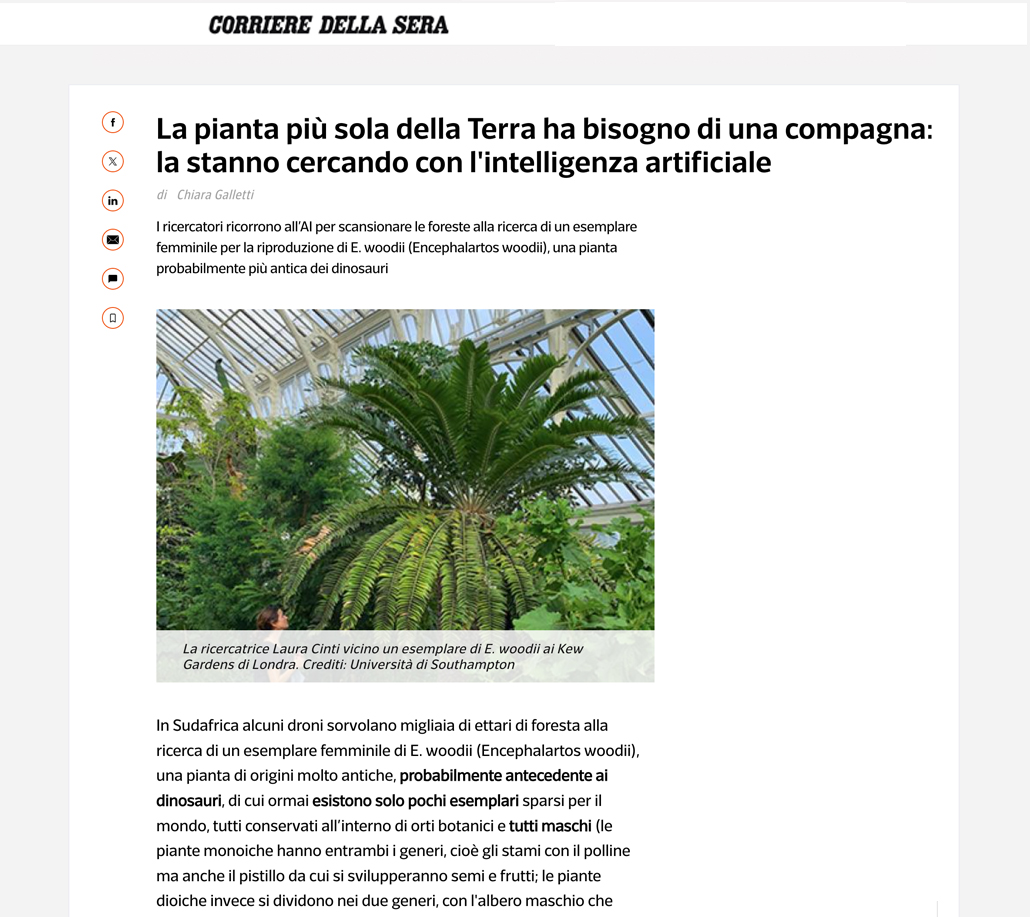
All existing specimens are clones of this plant and, just like the last wild specimen, they are all males. Both sexes are needed for reproduction and since no female has ever been found - cloning from offsets is the only way it survives as a true species.

IN SEARCH OF E. WOODII
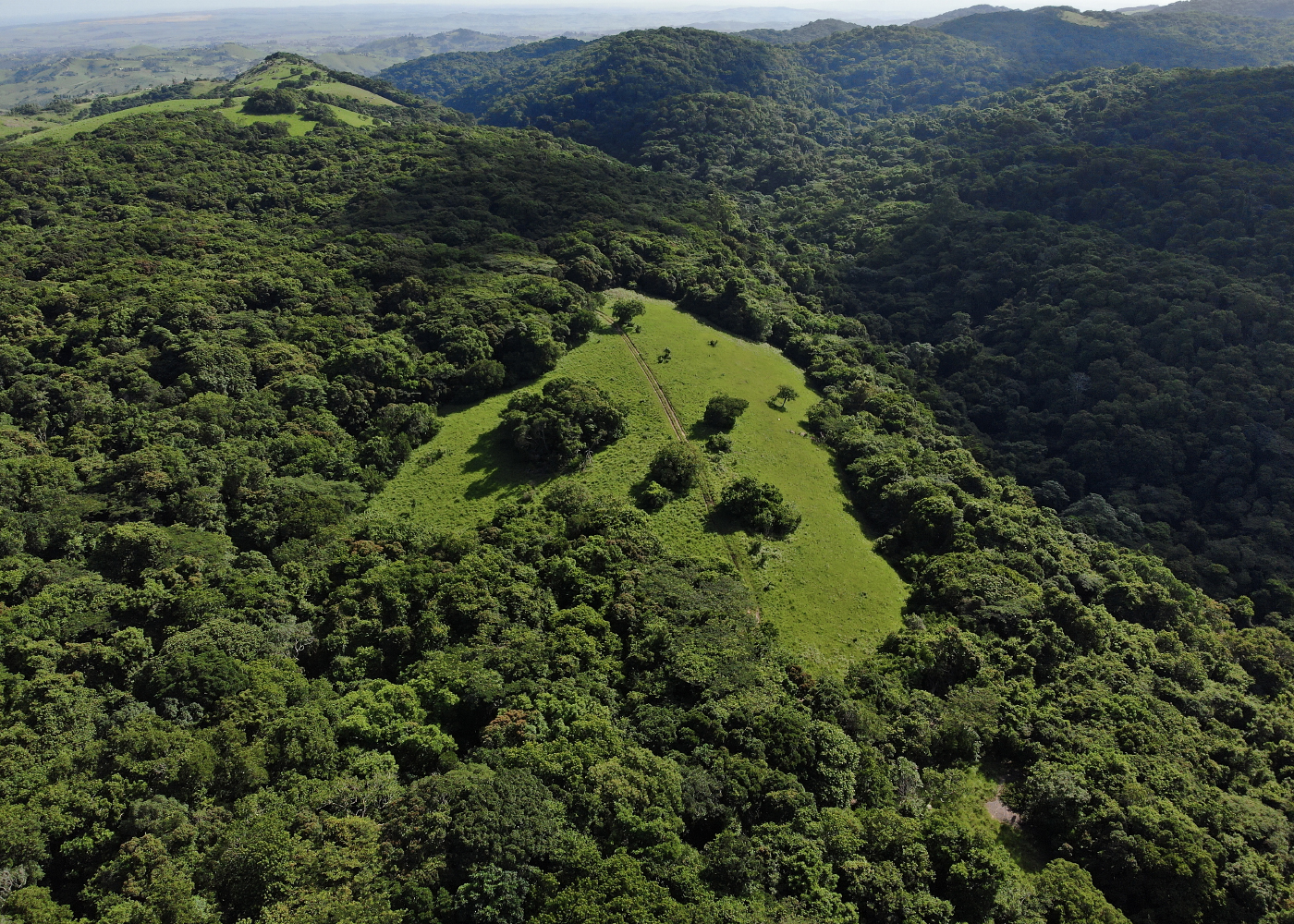
oNgoye Forest, South Africa
What if a female is still out there?
DRONE MISSION
Expanding The Search Area
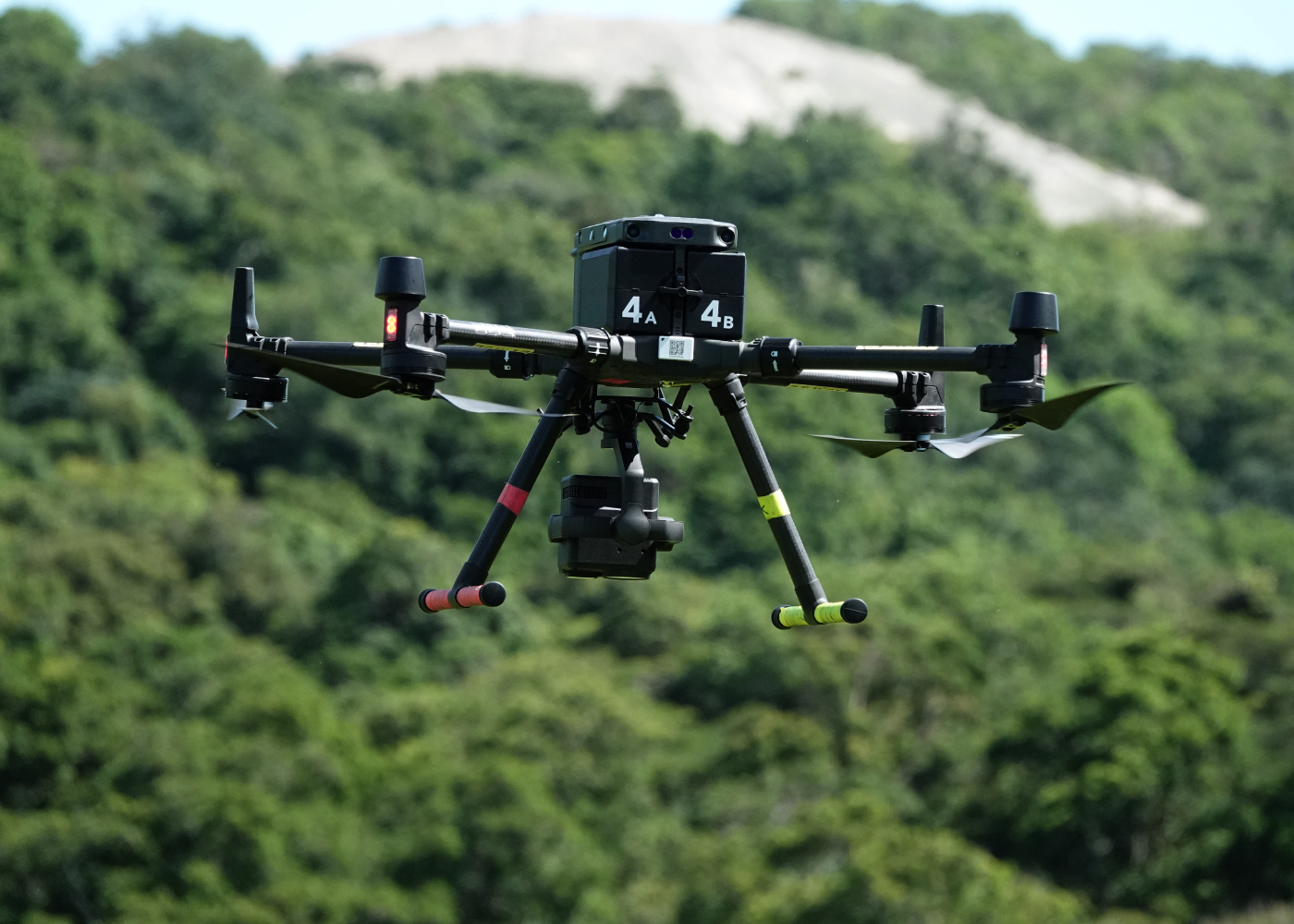
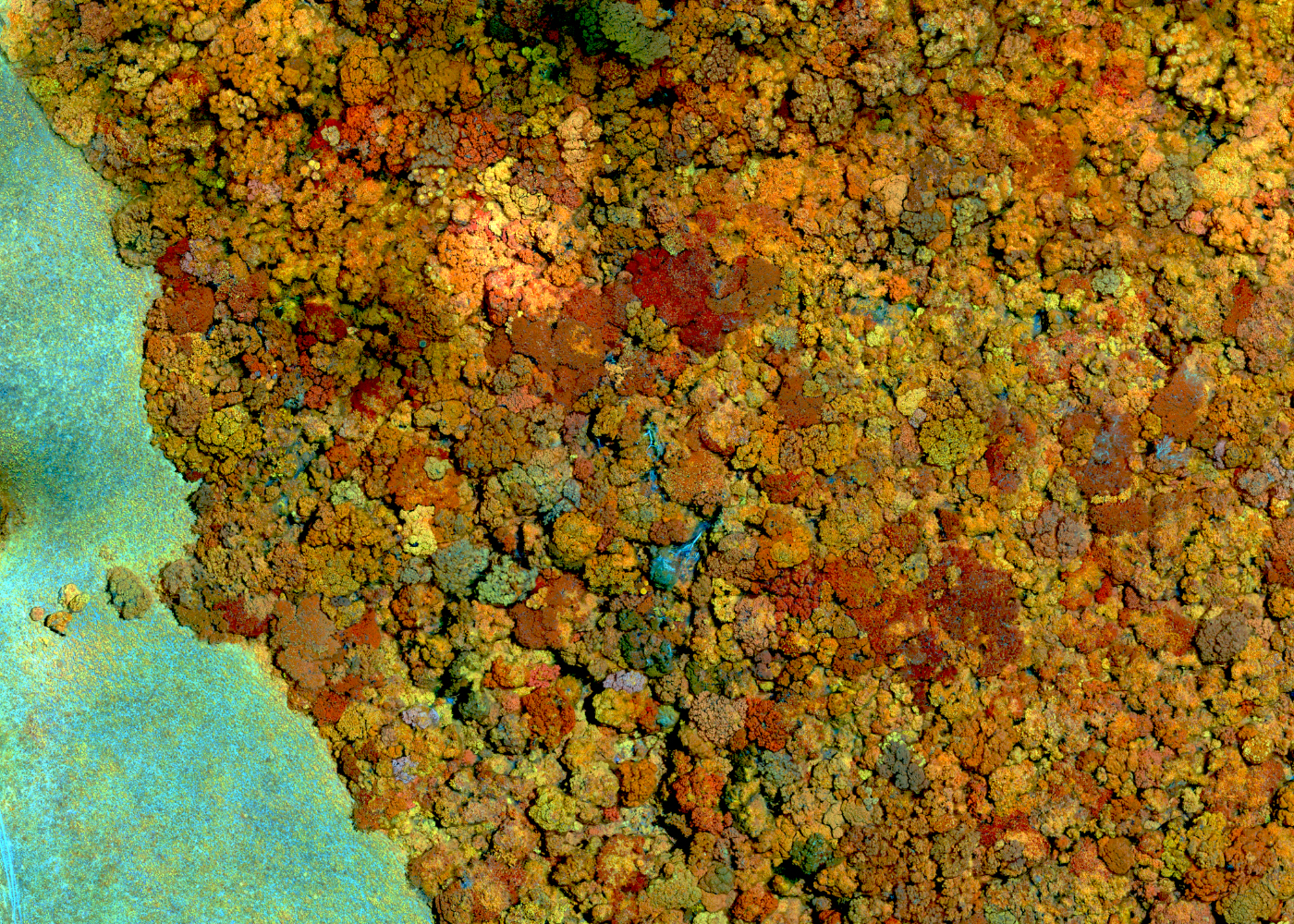
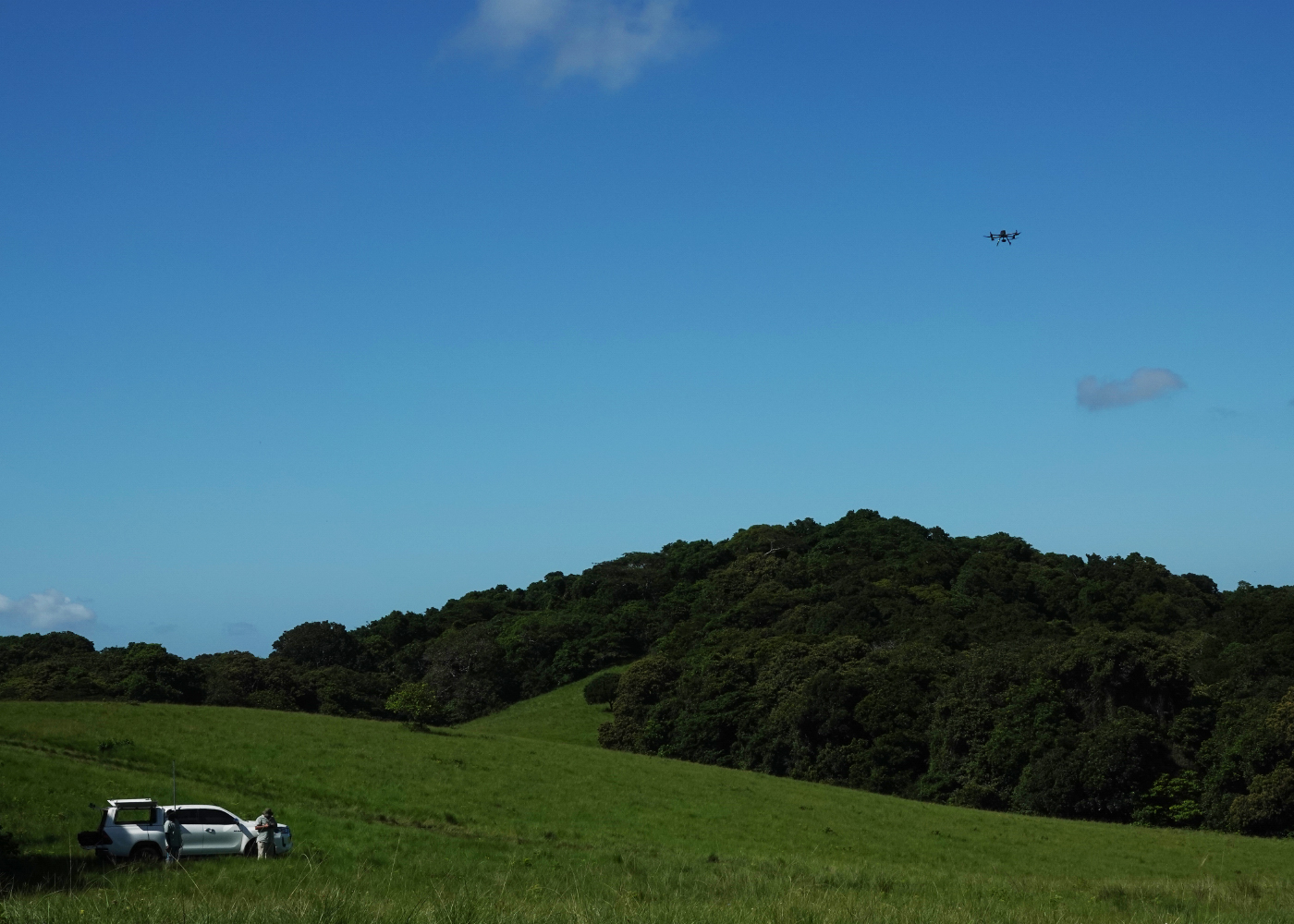
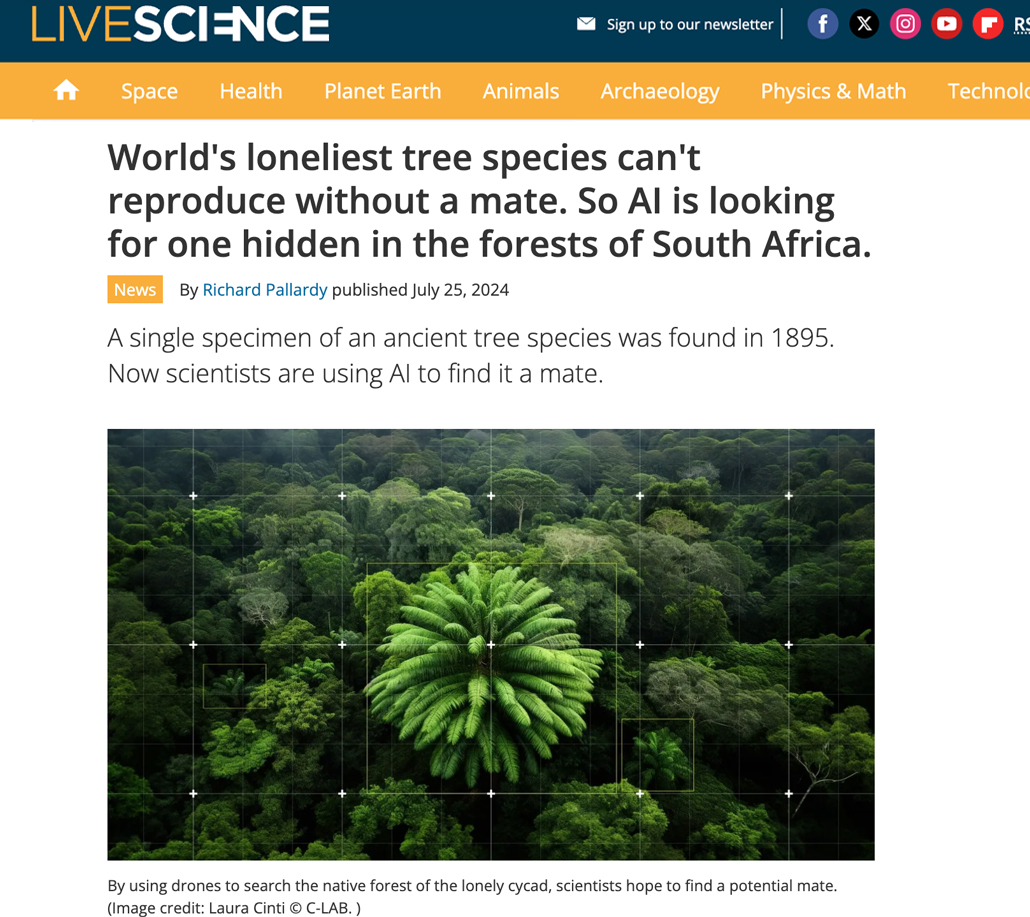
For the drone flight, a DJI Matrice 300 was equipped with a Micasense RedEdge-MX multispectral sensor and programmed to fly in a grid over two selected areas covering a total area of 195 acres collecting a total of 15,780 images.
Mosaic maps
Multispectral Imaging
Data from the drone missions were compiled to produce an extensive collection of photos. These photos were stitched together to create mosaic maps, which were visually analysed for the presence of cycads. Each plant has its own unique spectral signature and it's hoped that this can be used to more easily spot a cycad in the forest.
AI object detection
Generative AI
Refining the AI Model
The Search Goes On…
AI in the Sky opens discourses around the critical issue of biodiversity loss and technology’s role in environmental conservation. The project explores how AI, sensors and simulation can provide alternative ways of interpreting the world of plants and the use of drone technology to help map and understand the environment.
Ultimately, this project confronts the reality of species loss, while nurturing a hopeful quest to find a female E. woodii.
Visual Story
Video Mapping Installation
AI in the Sky has been exhibited as an single-channel audiovisual installation at:
- • Plurivers & Contingence, Centre Wallonie Bruxelles, Paris, France
- • A View from Above, Exposed Torino Foto Festival, Turin, Italy
- • AI Arts Festival, The Arc, Winchester, UK
- • (Get) In Touch, Ars Electronica × Istanbul Digital Arts Festival, Turkey
- • Connecting Nature, Art, and Technology, SIGGRAPH 2025, Vancouver Convention Centre, Canada
*Best in Show Award - • Coining Utopias, Taboo - Transgression - Transcendence in Art & Science, Kino Šiška, Ljubljana, Slovenia
- • Of the Earth Earthly Technologies to Computational Biologies, Diriyah Art Futures, Riyadh, Saudi Arabia
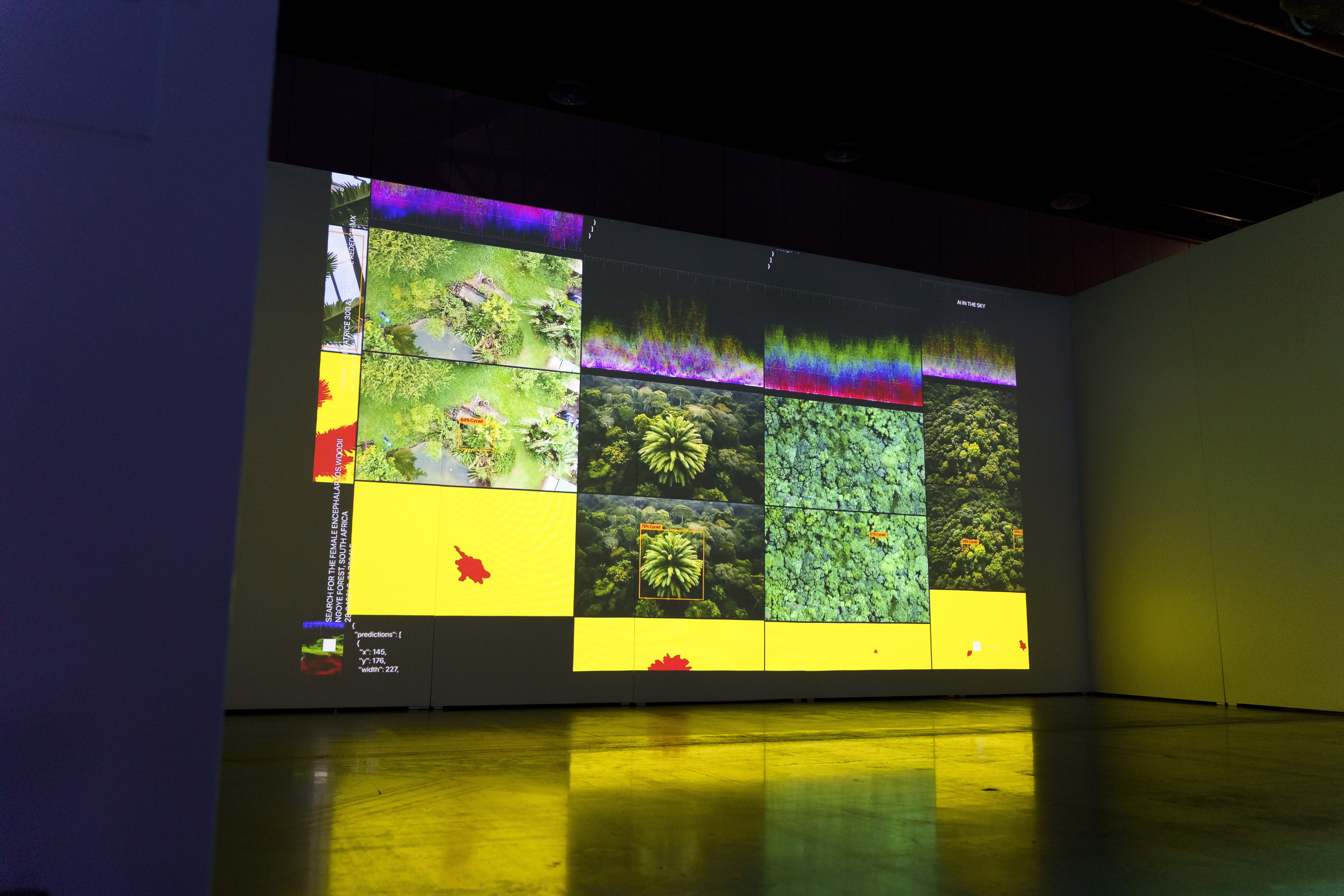
It tells a visual story of the search for the rarest cycad in the world using large and detailed dynamic maps, from our drone missions, combined with the use of an AI system learning, training and interrogating the map. The story highlights the process and visually dissects the map into potential areas that could harbor the plant.
Acknowledgements
& Credits

Dr Debbie Jewitt, Conservation Scientist and Drone Pilot, Ezemvelo KZN Wildlife.
Sharon Louw, District Ecologist, Ezemvelo KZN Wildlife.

Tim Baker, Drone Pilot, The Greater Together Foundation.
Neolan Munien, Drone Pilot, The Greater Together Foundation.
 Lucy Collie, PR & Communications, University of Southampton
Professor Ryan Bishop, Winchester School of Art, University of Southampton
This research was later supported by a postdoctoral fellowship funded through the AHRC-DFG grant [AH/W010526/1].

For more information get in touch.
AWARDS
& Nominations

Best in Show Art Gallery Award
S+T+ARTS Prize Nomination – Grand prize of the European Commission honouring Innovation in Technology, Industry and Society stimulated by the Arts 2025.


Finalist for Art-Science Category for
Falling Walls Science Summit 2024


Winner of the NOVA_XX Award as part of the COAL Prize (2023) in partnership with the Centre Wallonie-Bruxelles Paris.
MEDIA
Selected
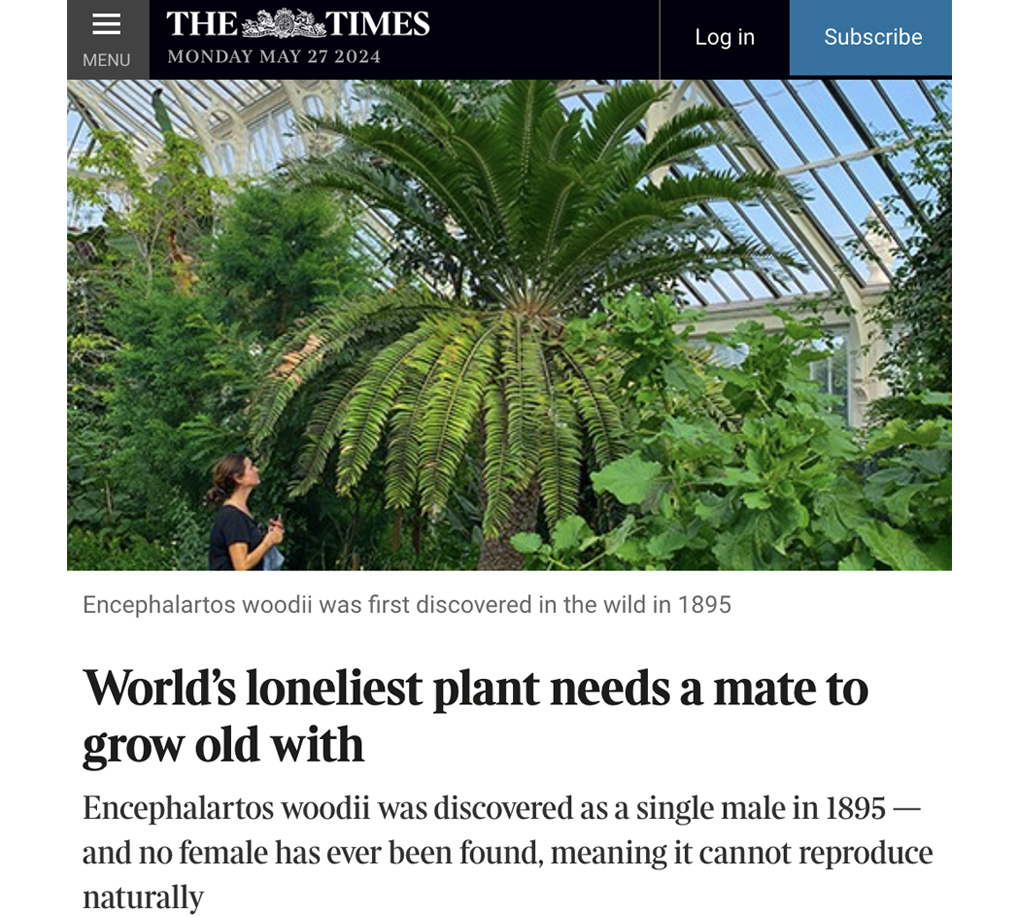
World’s Loneliest Plant Needs A Mate To Grow Old With, Tom Whipple, The Times (UK), 26 May 2024
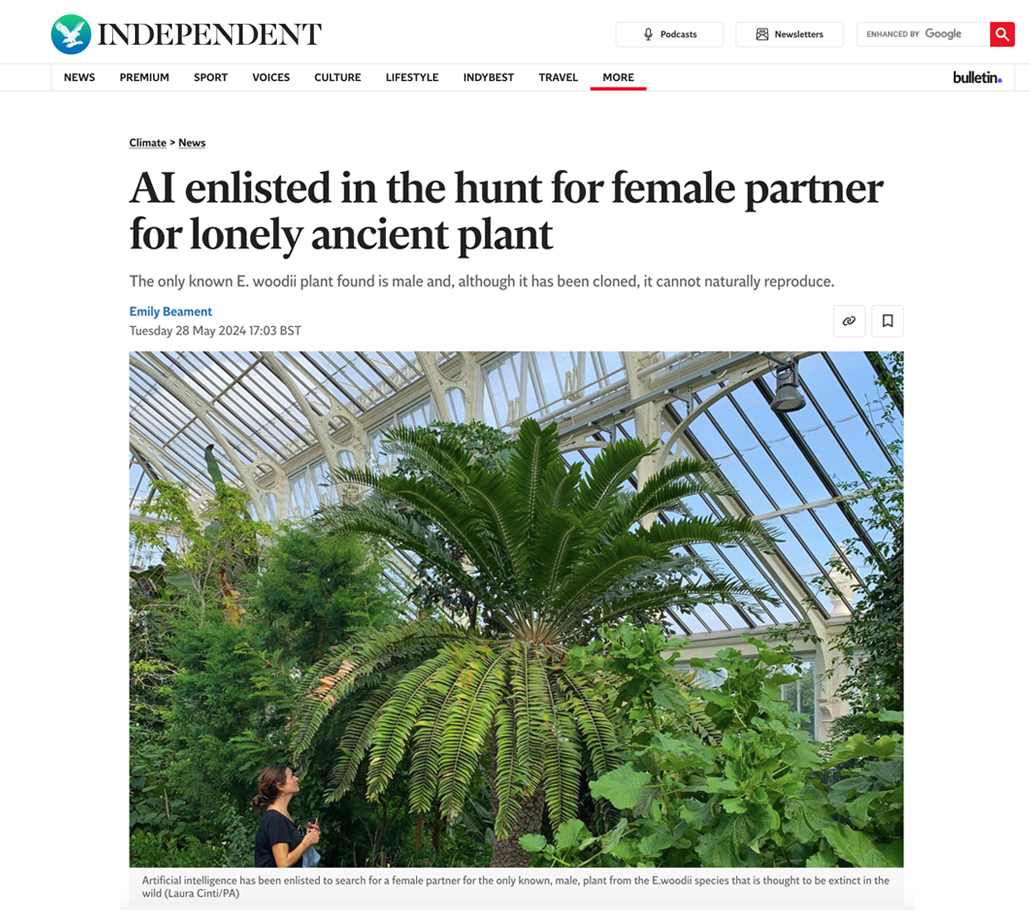
AI enlisted in the hunt for female partner for lonely ancient plant, Emily Beament, Independent (UK), 28 May 2024
AI helping find 'world's loneliest plant' a partner, BBC (UK), 29 May 2024
The high-tech hunt for a lonely plant’s partner, University of Southampton (UK), 28 May 2024
Científicos buscan pareja para una planta solitaria que sobrevive desde la era de los dinosaurios, Erika Montejo, National Georgraphic (Spain), 30 May 2024
AI scant 10.000 hectare bos op zoek naar partner voor "eenzaamste plant ter wereld”, Moonray Grunewald, VRT News (Belgium), 29 May 2024
El único ejemplar de una planta casi extinta al que los científicos le buscan pareja, Redacción Ambiente, El Espectador (Colombia) 6 June 2024
Usando IA, cientistas buscam companheira para a “planta mais solitária do mundo”, Maria Clara Rossini, Superinteressante (Brazil), 8 June 2024
La ricerca di una compagna per salvare E. woodii, la pianta più sola del pianeta, Simone Valentine, Wired (Italy), 24 June 2024
La pianta più sola della Terra ha bisogno di una compagna: la stanno cercando con l'intelligenza artificiale Chiara Galletti, Corriere Della Sera (Italy), 25 June 2024
The ‘World’s Loneliest Plant’ Could Soon Find a Mate With a Little Help From A.I., Sarah Kuta, Smithsonian Magazine (USA), 25 July 2024
World's loneliest tree species can't reproduce without a mate. So AI is looking for one hidden in the forests of South Africa, Richard Pallardy, Live Science (USA/UK) 25 July 2024
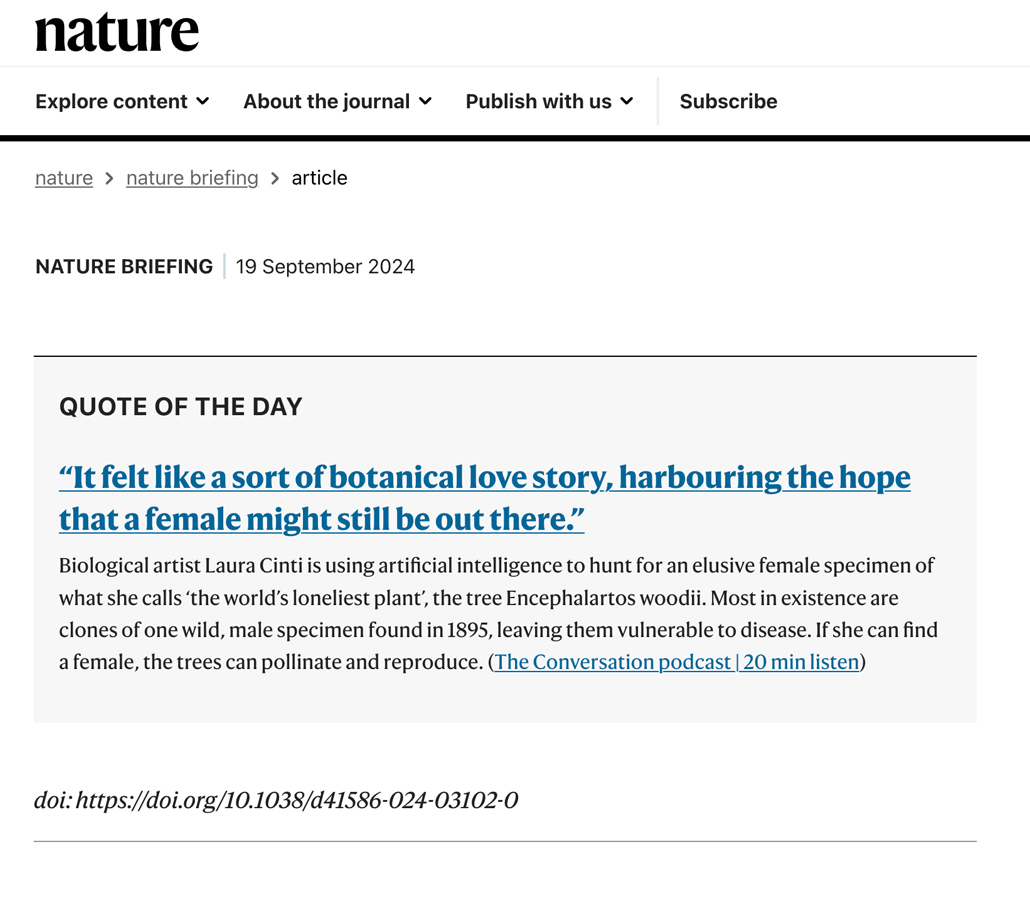
Nature Briefing: Quote Of The Day, Nature Portfolio, Springer Nature, UK, 19 September 2024
Wie ein Palmfarn mit Drohnen und KI vor dem Aussterben gerettet werden soll, Stefan Mey, Der Standard (Austria), 19 January 2026
Media
Selected
Wer weiß denn sowas?
Episode 1211, Das Erste, 5 December 2024
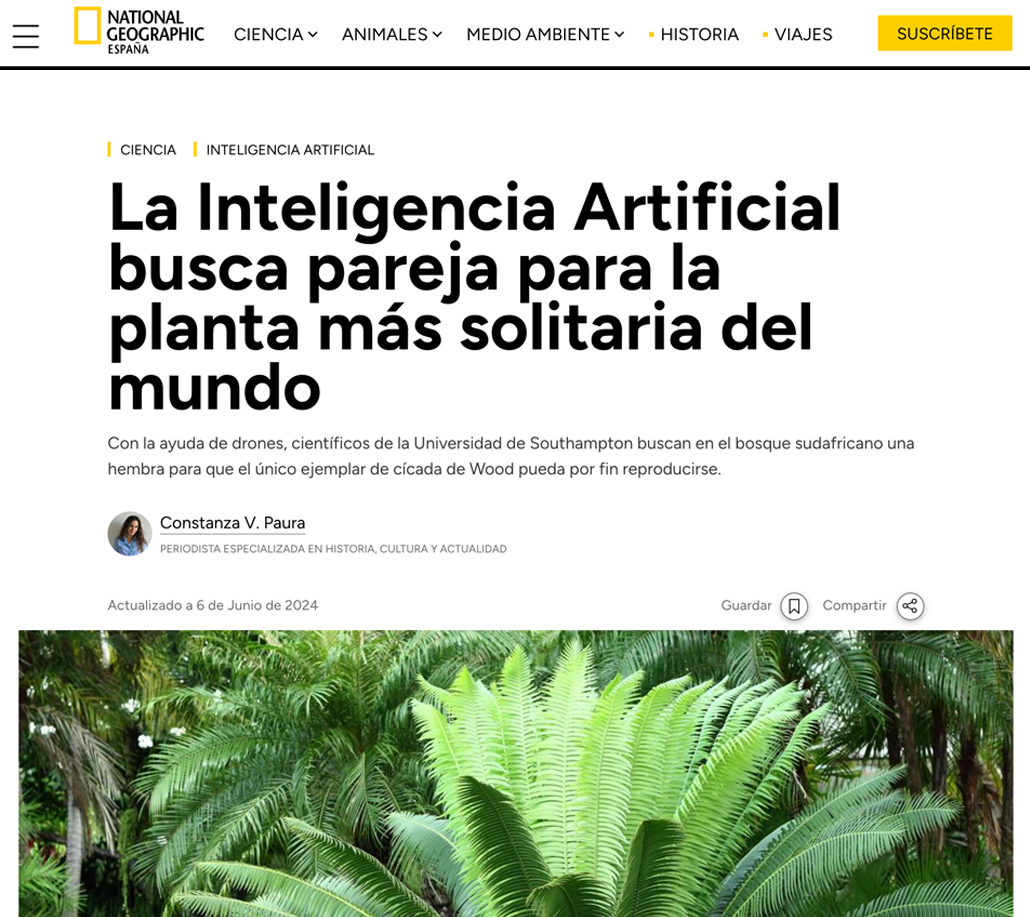
Esta solitaria planta busca pareja, y la IA podría ser su "celestina”
Constanza Vacas, National Geographic España, 13 June 2024
Have I Got News For You
Series 64: Episode 9, BBC (UK), 31 May 2024
What's right: AI hopes to find a mate for world's loneliest plant
ARA City Radio (Luxembourg), 30 May 2024
ARTBOX
LA7 Television Channel (Italy), 14 May 2024
Talks
& Texts
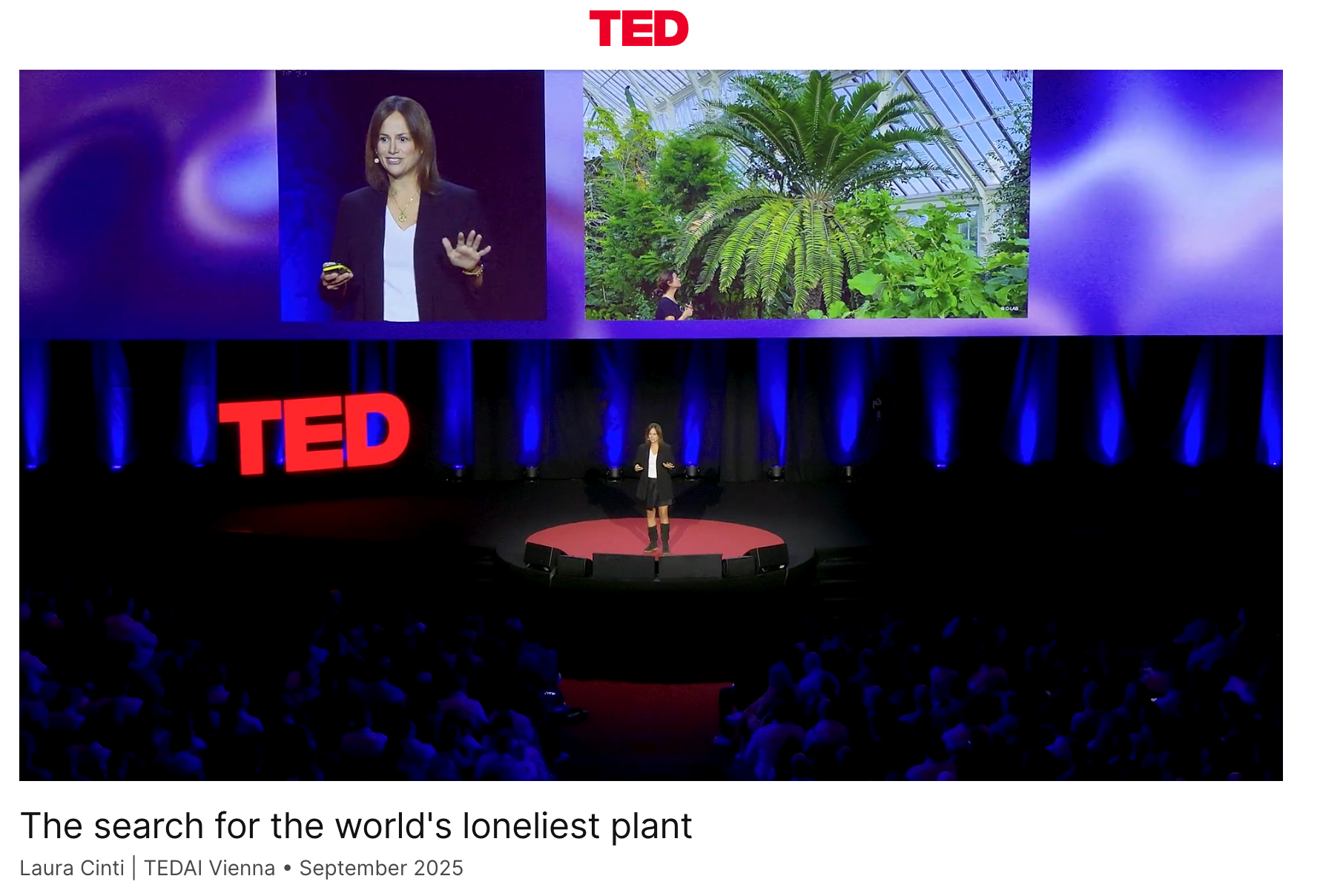
The Search for the World's Loneliest Plant
TEDAI, Hofburg Imperial Palace, Vienna, Austria, September 2025.
Disconnections
TreeArt Festival, Villa of Toppo Florio, Buttrio, Italy July 2025
AI in the Sky
SIGGRAPH Art Gallery Proceedings, Association for Computing Machinery (ACM), 2025.
In Search for the Rarest Plant: Art, Drones, and AI.
Leonardo. MIT Press, January 2025.
Between Absence and Presence: The Convergence of AI, Sensing Technologies, and Art
Plastir N°75, La Revue Transdisciplinaire de Plasticité Humaine, December 2024.
On the Hunt for the Missing Female.
Antennae: The Journal of Nature in Visual Culture, November 2024.
Searching for a Female Partner for the World’s ‘Loneliest’ Plant.”
The Conversation, June 12, 2024.