In August of 1771, Joseph Priestley, put a sprig of mint into a transparent closed space with a candle that burned out the air until it soon went out. After 27 days, he relit the extinguished candle again and it burned perfectly well in the air that previously would not support it. And how did Priestley light the candle if it was placed in a closed space? He focused sun light beams with a mirror onto the candle wick (Priestley had no bright source of light, and had to rely on the sun). Today, of course, we can use more sophisticated methods to light the candle like focusing light from a flood light through a converging lens, or by an electrical spark.
In another celebrated Experiment from 1772, Priestley kept a mouse in a jar of air until it collapsed. He found that a mouse kept with a plant would survive. However, we do not recommend to repeat this experiment and hurt innocent animals.
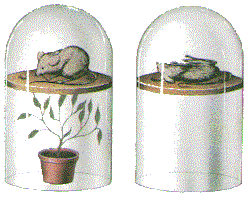
Credit: The National Science Teachers Association
These kinds of observations led Priestley to offer an interesting hypothesis that plants restore to the air whatever breathing animals and burning candles remove - what was later coined by Lavoisier "oxygen".
In these experiments, Priestly was the first to observe that plants release oxygen into the air - the process known to us as photosynthesis.