Visualising Stress
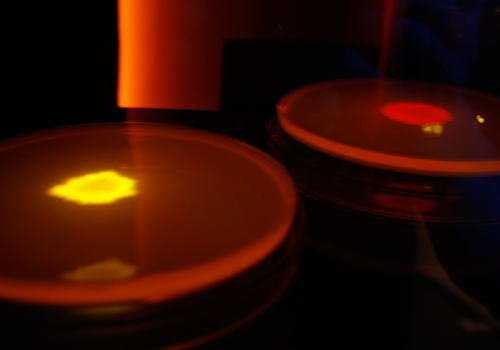
How it works
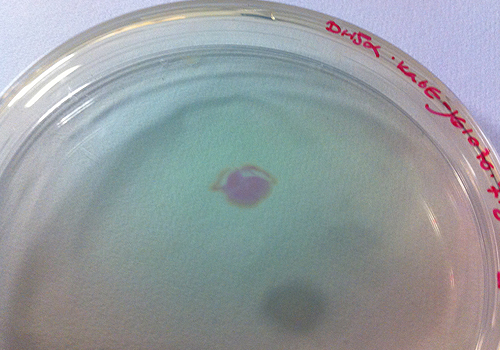
When reactive oxygen species (ROS) rise, the katE promoter activates and drives RFP expression, producing a red/pink fluorescence. The construct (katE → RFP, BBa_J06702) was assembled using idempotent design (standardised parts/interfaces) for precision and reproducibility. RFP’s pale emission remains visible in ambient light, supporting extended time-lapse capture.
Stress Responses
Swarming Dynamic
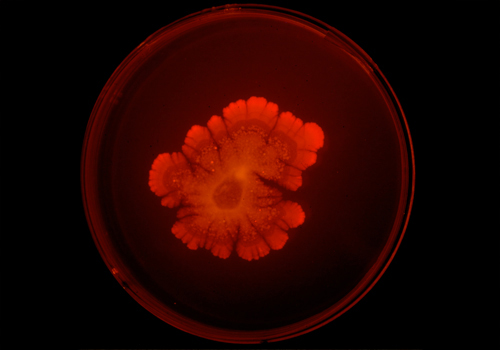
On swarming plates (soft, nutrient-rich agar over a harder base), colonies expand outward. As plates dry and environmental pressure increases, time-lapse imaging shows a moving red boundary at the migrating front—the point of greatest challenge. This creates a dynamic map of stress across the colony over hours to weeks.
Approx. month of time-lapse showing bacteria blushing red as move into hard agar on a swarming plate.
Red?
Stress as Representation
Switching the reporter from green to red borrows a familiar code for strain and alert, flushed skin, warning lights, “stop” against “go” green. These associations don’t alter the biochemistry, but they shape how audiences read the signal. Here, colour functions as a translation layer: useful for public legibility while reminding us not to collapse cultural rules back onto biology.
Exhibition
Setup & Requirements
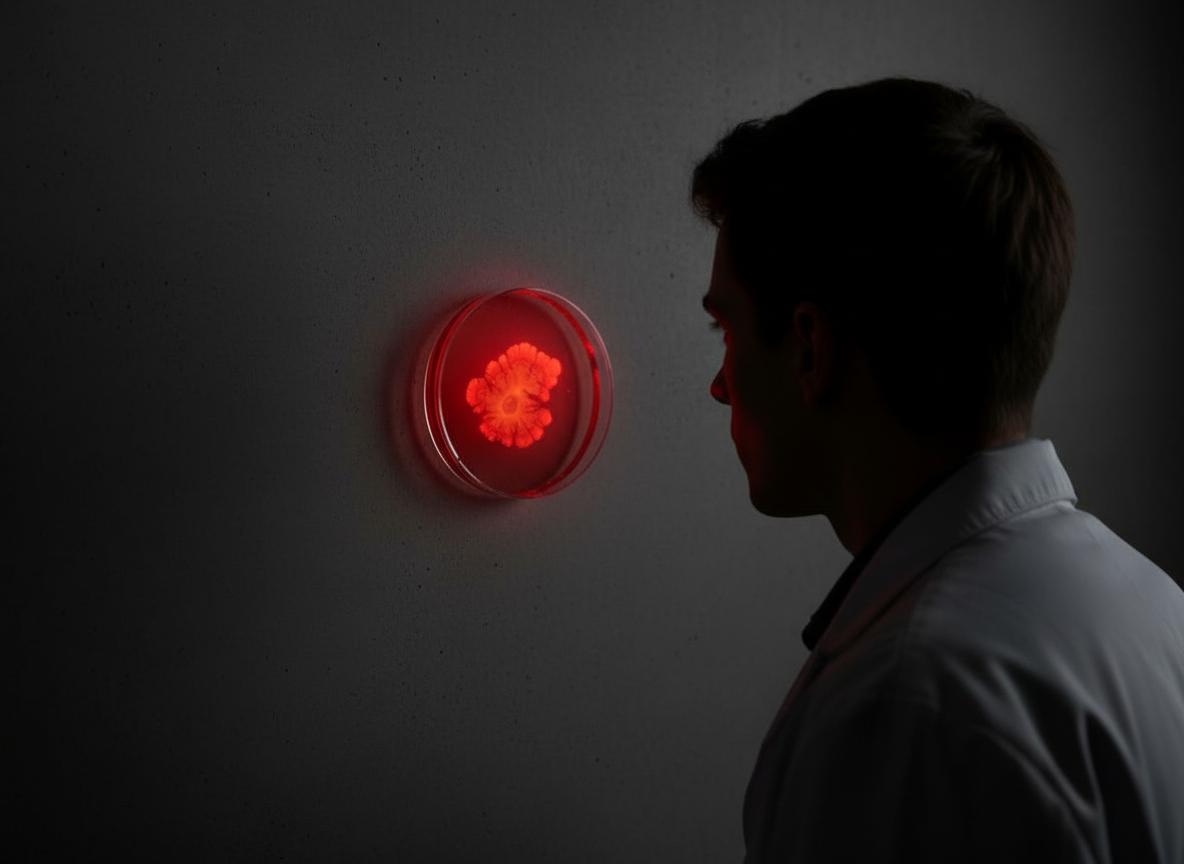
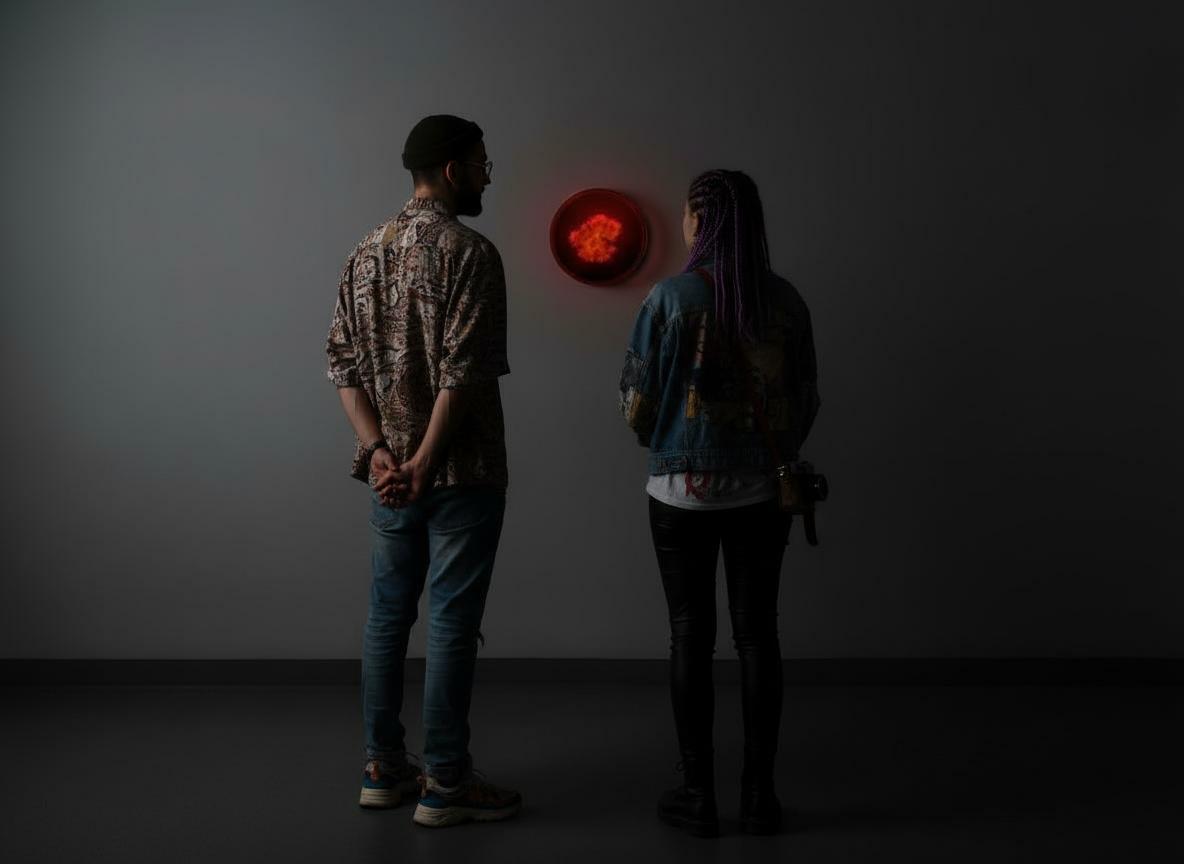
The setup can be exhibited wall-mounted or on a tabletop plinth, the self-lit glass Petri dish integrates excitation light and an emission filter, requiring mains power and scheduled plate replacement.
KatERED: Red Blush, 2012 Media: Living bacteria with oxidative-stress reporter (katE→RFP, BBa_J06702) plasmid in custom glass Petri dish, integrated LED excitation and optical emission filter, wall mount, control electronics. Dimensions: Dish Ø 30–35 cm (custom), depth 2–3 cm; wall unit approx. 45 × 45 × 10 cm (variable). Power: 100–240 V AC, <30 W. Edition: Ed. of 3 + 2 AP (installation with replacement plates).
KatERED: Red Blush, 2012 Media: Living bacteria with oxidative-stress reporter (katE→RFP, BBa_J06702) plasmid in custom glass Petri dish, integrated LED excitation and optical emission filter, wall mount, control electronics. Dimensions: Dish Ø 30–35 cm (custom), depth 2–3 cm; wall unit approx. 45 × 45 × 10 cm (variable). Power: 100–240 V AC, <30 W. Edition: Ed. of 3 + 2 AP (installation with replacement plates).
Acknowledgements
& Credits
Development & lab work to produce KatRED was conducted at the University of Westminster.

KatRED was exhibited live at Art from Synthetic Biology, UK’s first public exhibition featuring living genetically modified microorganisms at The Royal Institute of Great Britain.
Sincerest gratitude to Dr Mark Clements.


The research is supported by a Doctoral Award from the Arts and Humanities Research Council and University of Westminster.