Within plants' internal spaces (chloroplast), the pigment molecule, chlorophyll, governs underlying autotrophic processes. Chlorophyll orchestrates the conversion process of light to chemical energy. Its ability to absorb light and its conversion to chemical energy pushes a series of chemical reactions, a process known as photosynthesis. The light energy (photo) conversion process of photosynthesis drives the manufacture of organic molecules of food - a phenomena underpinning virtually all life forms, as we know it. The sheer importance of this molecule cannot be understated. In this experiment, chlorophyll was extracted through a method of purification from plant tissues (spinach leaves). In this process the leaves were subjected to various destructive protocols, which involved dehydration (two hours in the oven at 40°C till the leaves are dry and brittle), pulverisation (with mortar and pestle), immersion (in 10ml of isopropanol alcohol) and sedimentation (centrifuged for 5 minutes at 12,000 rmp). In the final steps, the supernatants (the green liquid above the pellets) were decanted into separate tubes. Upon exposure to UV light, the chlorophylls (green liquid) absorb the light's energy but given its disembodied state, outside the plant, the energy cannot be converted to Adenosine 5'-triphosphate, ATP, (the 'energy currency' of cells) and is instead released as heat and fluorescence - turning the green liquid to a 'beautiful red glow'.
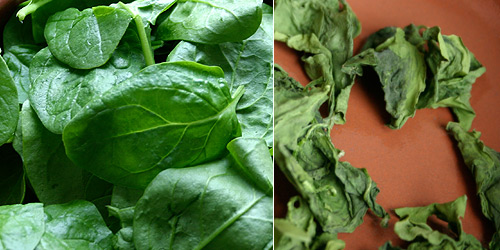
Spinach leaves are dried for a couple of hours in the oven at around 40°C, until they become dry and brittle.
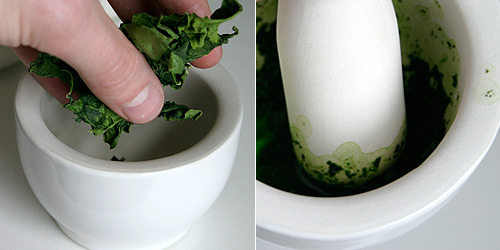
The leaves are placed in a mortar, with a dash of ethanol or isopropanol (5-10 ml) and grounded well.
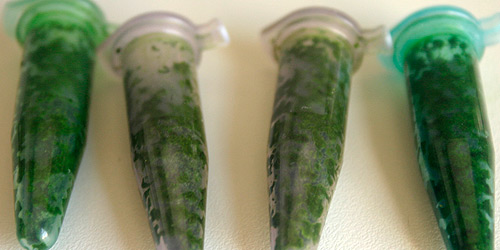
The small microtubes are filled with the mixture of alcohol and leaves.
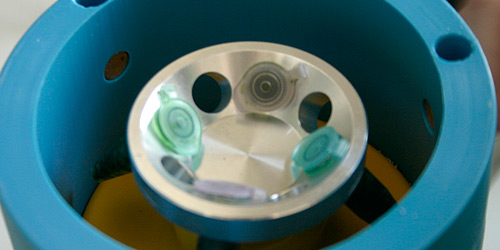
Two microtubes with the mix where put in a microcentrifuge for 5 minutes at around 10000-13000 rpm.
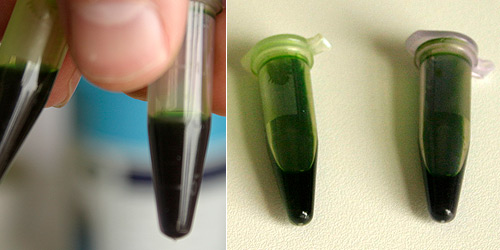
This separated the mix into a solid and liquid layer, the solid layer was discarded and the liquid containing the chlorophyll was kept.
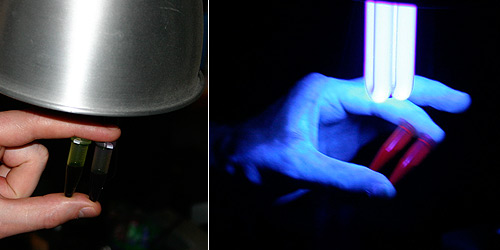
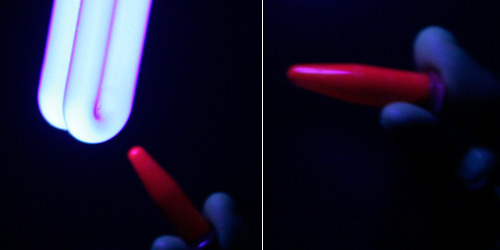
Under normal light the chlorophyll in normal light is of course green but with a UV light, the purified chlorophyll with the alcohol takes on a luminance orange-red colour. When chlorophyll molecules receive energy in the form of light, one of their electrons is briefly pushed away causing water to split. A special molecule called the primary electron acceptor quickly snaps up the electron before it manages to return to the molecule. This mechanism is used to drive a proton flow that generates energy for plant through a stepwise return of the electron. In absence of these electron snappers – the electron returns directly to the chlorophyll and the energy released – produces a fluorescent glow. This light can be produced using a very low-tech collection of material; spinach, alcohol, a mortar and a centrifuge.
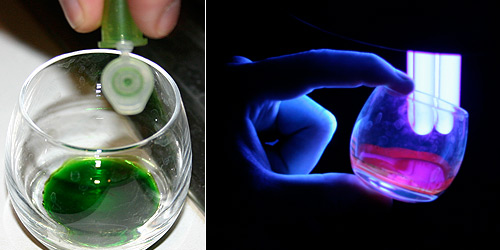
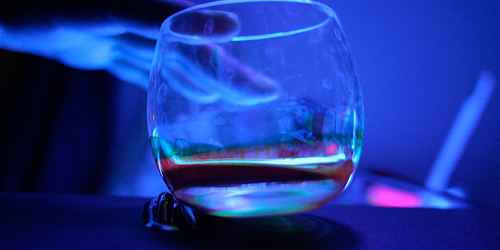
The UV light shows what happens as the chlorophyll reacts with light. Excited electrons are pushed away from its ground state, but chlorophyll which is one of the strongest oxidising agents found in organic material pulls it back. Energy is released - it glows and produces heat.
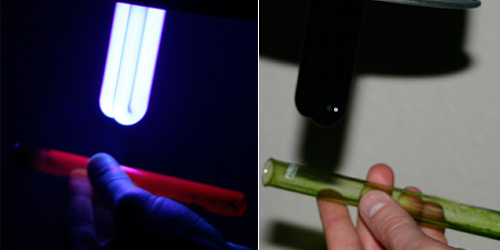
By shaking a test tube the chlorophyll-alcohol mix spreads and the glow distributes.
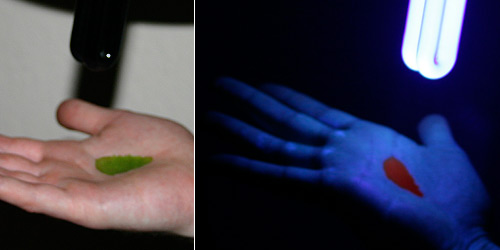
Pouring a few drops onto your hand also produces a startling glow of red-orange. Certainly, one can draw resemblances between chlorophyll and blood, when looking at extracted chlorophyll under UV light. These connections do exist. The haemoglobin molecule of our blood cells exhibits a remarkable similarity to the structure of chlorophyll molecule. Thought functions differ, they are both pigment molecules taking in light and exhibiting radiation properties. Their colours are associated with the metals they contain - red (iron) for blood and green (magnesium) for plants.


