Ted Pietsch, of the University of Washington, disagrees and believes the title belongs to two males of the species Photocorynus spiniceps, which measure just 6.2 and 6.5 millimetres in length — smaller than a grain of rice. Intriguingly, these tiny males live as permanent parasites attached to the body of the much larger female, which grows to 46–50.5 millimetres. This extreme sexual dimorphism is unique among vertebrates.
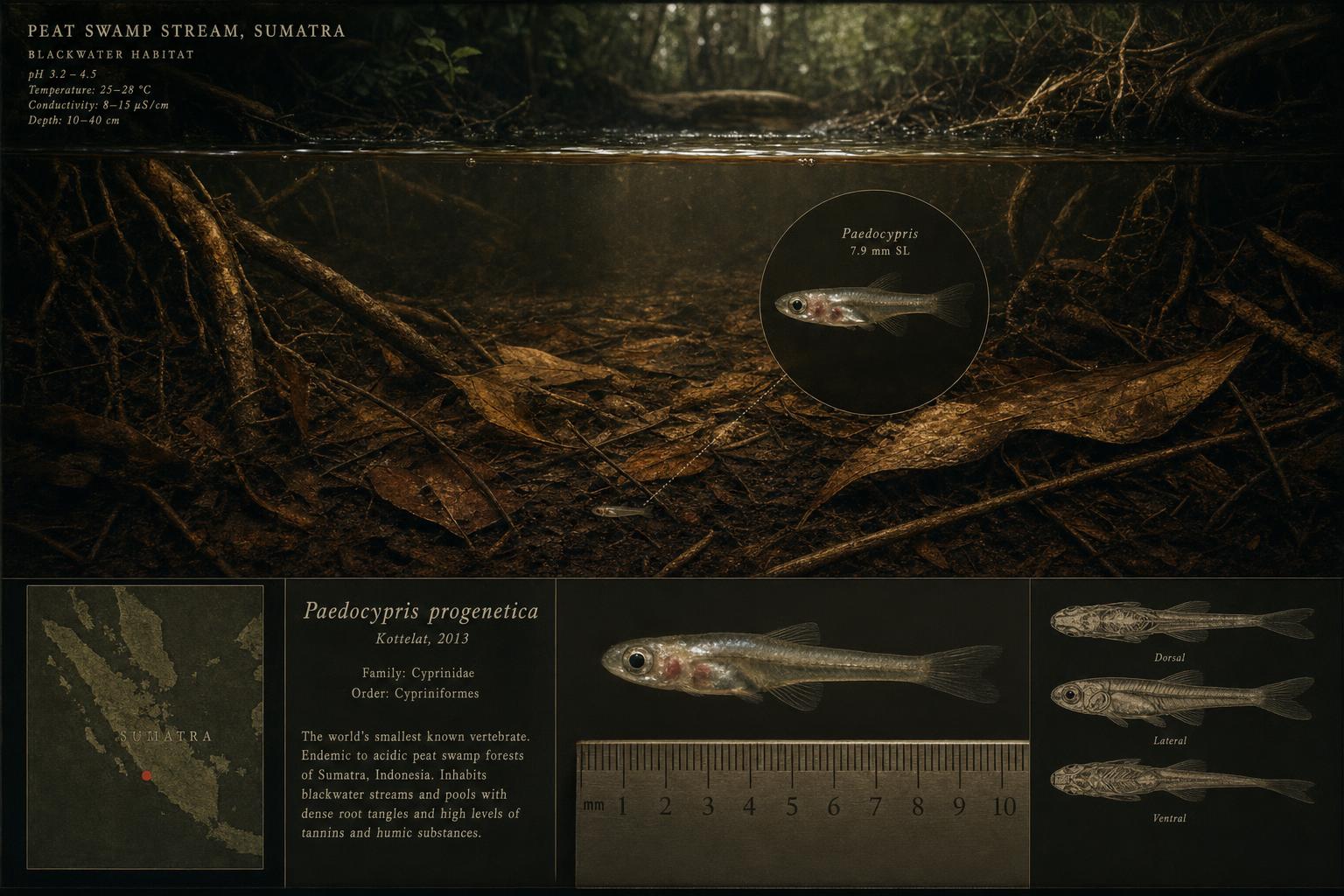
Meanwhile, the Paedocypris progenetica from Sumatra holds its own remarkable distinctions: it survives in highly acidic blackwater swamp streams with a pH as low as 3 — more acidic than vinegar — an environment almost no other vertebrate can tolerate.
Where does it live?
Paedocypris progenetica inhabits the peat swamp forests of Sumatra and Borneo — one of the most extreme freshwater environments on Earth. These blackwater streams are stained dark brown by tannins leaching from decaying vegetation, leaving the water nearly opaque and intensely acidic.
The fish survive in pools that can be just a few centimetres deep during dry season, hiding among submerged roots and leaf litter on the forest floor. The combination of near-zero visibility, crushing acidity and seasonal drought has driven the evolution of remarkable physiological adaptations — including a specialised pelvic girdle in males, thought to help them grip surfaces in fast-flowing water.
Tragically, the peat swamp forests of Southeast Asia are among the most threatened ecosystems on the planet, cleared at pace for palm oil and timber. As their habitat disappears, so too does any chance of fully understanding the biology of the world's smallest fish.