Synthetic life is the idea of building devices from interchangeable DNA parts. These devices are assembled inside microbes to create programmable living machines. Although biologists have been exchanging genes between different species for over thirty years, genetic engineering remains more of a craft rather than a mature engineering discipline.
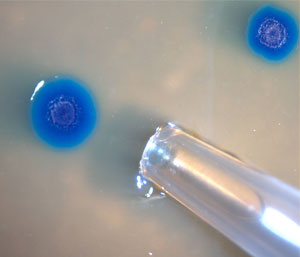
The successful transplanted genome of one species of bacteria into another was recently reported by the J. Craig Venter Institute. The transplantation technique allows the transferred genome to take over the host cell apparatus and start producing proteins based on its sequence. It remains unclear if the original DNA is destroyed or simply sidelined through this intervention.
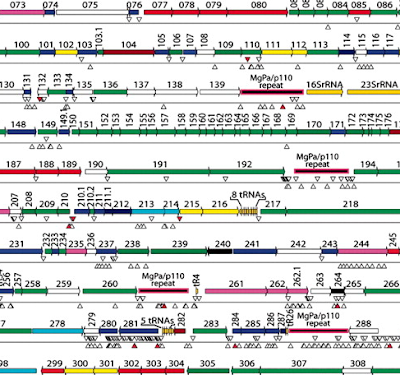
Above: Mycoplasma genitalium has the smallest genome of any organism that can be grown in pure culture.
Their experiment was done by purifying the full DNA from one kind of Mycoplasma and showed its ability to take over another, hence making the cell produce proteins specified by the inserted DNA.
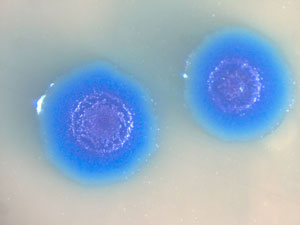
This technique is said to be the first big step in overcoming a hurdle in synthetic biology. However, many remain sceptical about making this accomplishment a hype as it is a long way from actually having any industrial uses as Mycoplasma is currently unsuited for these conditions. What is unique about Mycoplasma is their lack of cell wall so they are often seen as pathogens on another culture and therefore are big source of contamination in labs. The principle of doing this does however hold a key proof to realizing the ultimate goal of creating a synthetic organism according to Venter. "We are committed to this research as we believe that synthetic genomics holds great promise in helping to solve issues like climate change and developing new sources of energy." One such promise would be converting CO2 in the atmosphere to methane which can be used to fuel cars and according to Venter could lie as little as 5-10 years away.
The next step is to transplant a fully synthetic bacterial chromosome into living organisms and if successful, "boot up" the new entity.