In 1877, the year that he announced the presence of canali (“channels”) on Mars, Schiaparelli had turned the Brera Observatory’s 8.6-inch Merz refractor on Venus. Thirteen years later he cited these seemingly stationary features as evidence that Venus probably has a very slow “captured” rotation period of 225 terrestrial days, turning on its axis in the same interval that it takes to complete an orbit around the Sun.
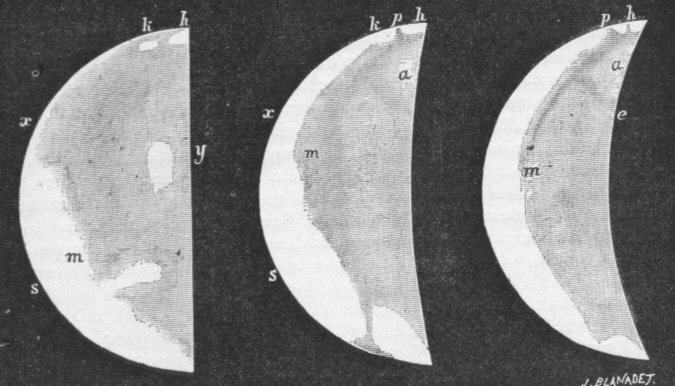
Percival Lowell, a Boston billionaire, philanthropic scientist and great admirer of the Italian astronomer, had setup his observatory in Flagstaff insisting that it was the unsurpassed tranquility and transparency of the atmosphere at his observing site, located at an elevation of 7,000 feet, that allowed him to see as “perfectly distinct and unmistakable” planetary markings that had eluded observers who did not enjoy the advantage of his “sea-level”.
In the summer of 1896, Lowell had just installed a superb new 24-inch refractor made by the Alvan Clark firm in a dome on top of Mars Hill overlooking the town of Flagstaff, Arizona. He had time to kill as he waited for Mars to make its next close approach in December, so on 21 August he had his first look at the small, gibbous disk of Venus.
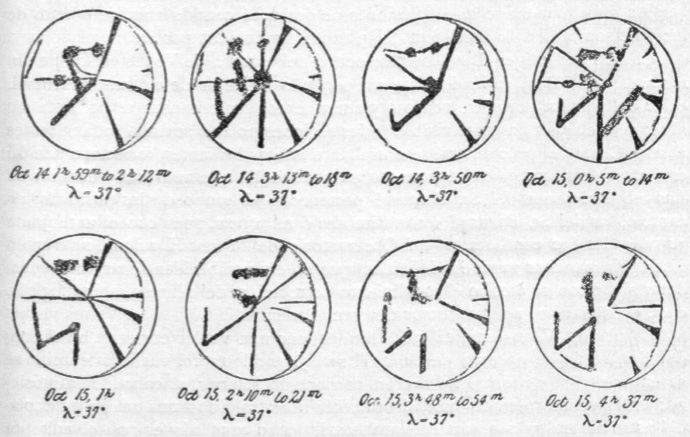
After making the necessary modification an array of streaks and spots could be seen as if a wheel radiated from a central hub. His assistants took turn sketching the planet but were unable to see what Lowell had sketched, apart from his secretary. Lowell commented that his trained assistants were unable to see as they had become pre-convinced with ideas and did not have the fresh approach like his untrained secretary.
Rather than transient clearings in clouds shrouding the planet’s surface, Lowell imagined the spokes and nodes as permanent surface features — “rock or sand weathered by aeon's of exposure to the Sun” seen through the “diaphanous straw-colored veil” of a dense but strangely transparent atmosphere.
Soon after Lowell's sketches appeared at the Royal Astronomical Society, Captain William Noble wrote: “I do not know whether Mr. Lowell has been looking at Mars until he has got Mars on the brain, and by some transference transcribed the markings to Venus.”
Eugène Antoniadi, commented sarcastically: “I refrain from discussing the aphroditographic work of most of our contemporaries, who forgetting that Venus is decently clad in a dense atmospheric mantle, cover what they call the ‘surface’ of the unfortunate planet with the fashionable canal network.”
Lowell quickly counterattacked, employing a tactic that had served him well in arguments with critics of his Martian canal network - claiming the unsurpassed location of his observing site. However, the barrage of criticism soon took its toll, and for four years he would be sidelined with “neurasthenia”, the term used at the end of the nineteenth century to describe what we would now call depression.
While resting, his assistants where still mounting a spirited defence of his employer jibing: “No one is entitled to cry out against us until he can show that his atmosphere is approximately as good as the one through which Mr. Lowell discovered these markings.”
In 1898, Edward Emerson Barnard of the esteemed Yerkes Observatory arrived at Flagstaff to have a look for himself. On the sole evening of tolerably good seeing during his visit, Barnard was unable to make out any features on Venus, yet he noted with alarm that one of Lowell’s assistants, “saw the usual Flagstaff markings”.
Later Lowell' assistant in charge Andrew Ellicott Douglass who had criss-crossed the Arizona Territory evaluating the seeing at various locations, noted: “Of all the places I tried in Arizona in ’94, Flagstaff is probably next to worst. The trouble seems to be that these mountains project up into the great stream of air moving overhead and cause eddies of various kinds.”
Lowell’s choice of Flagstaff had stemmed in large measure from its proximity to the railroad.
However, during Lowell’s prolonged convalescence, Douglass quietly began to observe “artificial planets” — featureless little globes placed almost a mile from the telescope— and to his alarm soon realized that he could ‘see’ many of the markings that appeared in Lowell’s drawings of Venus.
Lowell who had been resting in the French Riviera completing his memoirs. Shortly after he returned to Flagstaff to continue his work on Venus starting with sacking Douglass for posting misgivings on Lowell's observations stating that Lowell's “methods were not scientific... I fear it will not be possible to turn him into a scientific man”. However, the artificial planets observed by Douglass had manifested some doubt in Lowell.
In 1902 he published a retraction of his Venus work in the German journal Astronomische Nachrichten, an event unique in the career of this egotistical, strong-willed man. For a time Lowell would attribute the spokes to “optical effects of a curious and — astronomically speaking — of a hitherto unobserved character”. He speculated that the markings “might be caused by the eye wandering quickly from one of the dark indentations [along the limb] to the center, and thus dulling unconsciously a path along the retinal rods.
Yet when Lowell resumed observing Venus the following year, the spokes reappeared, staring back at him “with a definiteness to convince the beholder of an objectiveness beyond the possibility of an illusion”. Lowell recorded spurious linear features on virtually every body in the solar system he surveyed — an intricate, rectilinear network of irrigation canals on Mars, cracks on Mercury, bizarre lineaments on the Galilean satellites of Jupiter, and chevrons between the belts of Saturn.
The ability of such narrow exit pupils to render visible defects in the lens of an observer’s eye was described by Douglass in an article “Atmosphere, telescope, and observer” that appeared in the June 1897 issue of Popular astronomy:
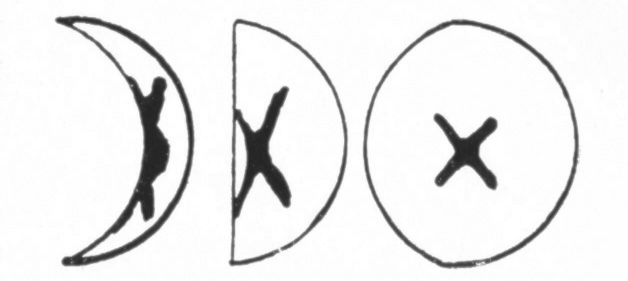
A second, perhaps even more plausible explanation was proposed soon after the present authors published a popular account of Lowell’s Venus observations in the sky and telescope. Several ophthalmologists quickly pointed out that by stopping down his telescope so severely, Lowell had effectively converted it into an ophthalmoscope. Used to examine the “ocular fundus”, the concave interior surface of the eye opposite the lens, the ophthalmoscope shines a narrow pencil of light through the pupil of the eye and contains a perforated inclined mirror or a beam-splitter to permit the examiner to look along the axis of this incident beam with the aid of a low-power microscope.
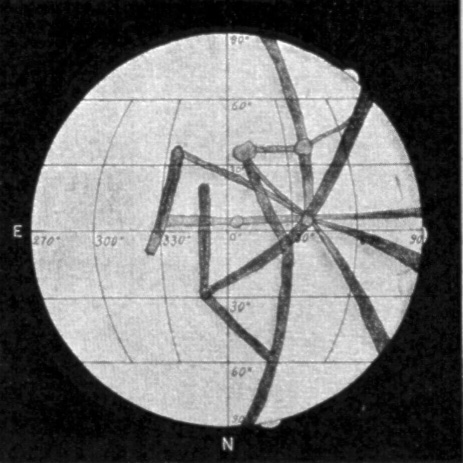
The ocular fundus is the only part of the human body where the vascular network can be vital for diagnosing pathological conditions of the eye such as glaucoma and can also reveal early signs of systemic disorders like diabetes, hypertension, and intracranial disease, and so visualizing and documenting the ocular fundus have long been of great interest to physicians.
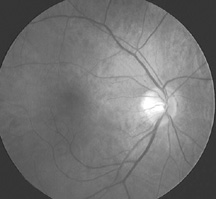
The central artery of the retina, a branch of the ophthalmic artery, sends a diverging network of vessels from a feature called the “optic cup” to supply blood to the retina; the network of veins draining the retina also converge at this location. These vascular structures overlie the photoreceptor's, so patients undergoing an ophthalmoscopic examination are often able to catch fleeting glimpses of the silhouettes of their branching retinal blood vessels, particularly when the light source is in motion. These vessels were formerly known as “Purkinje’s tree” after Jan Evandelista Purkinje (1787–1869), the Bohemian physiologist who first described their structure.
The retina of the eye is the only part of the body where relatively large blood vessels may be inspected without surgical intervention. These branching vessels lie very close to the receptor cells and cast sharp shadows on most regions of the retina. You may wonder why these shadows do not show up in one's field of vision. The answer is that the brain has the capacity to suppress disturbing images of this sort that are always in the normal direct line of vision.
- Hold a penlite with your right hand against the eyelid of your right eye at an angle of 45° to the right. The eyelid may be open or closed. If the eyelid is open, look at a dimly lit wall. If the eyelid is closed, do not face a brightly lit window.
- While exposing the eye to light, move the penlite from side to side to produce the Purkinje image. The amount of movement should be very slight, only a few millimeters from side to side. A most striking image can be produced if this experiment is performed in a dark closet.
It is notable that Lowell’s sudden death in 1916 was caused by a cerebral haemorrhage, usually the culmination of severe hypertension. The retinal blood vessels are often dilated and rendered more prominent in persons suffering from hypertension or exposed to high altitudes.