The Shanghai Biennale has become China’s most important contemporary art exhibition bridging contemporary culture with the public. The director, Mu Duanzheng, describes this biennale as having a distinct position in the art world and embodies Shanghai’s vision and culture.
This year’s biennale is themed hyperdesign and explores urban construction, aesthetics, functionality, life and culture. From the standpoint of the organisers’, design is a core element of creative culture and industry. Shanghai is claiming itself as the creative leader of China and with this biennale it aims to explore methods of production and utopia, dividing itself into three types of design; artistic design (artistic production methods), design for daily life (individuals urge to plan ones own life) and social design (social idealism and utopian dreams).
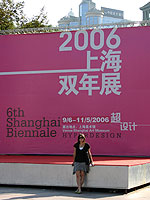
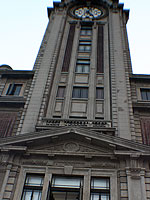
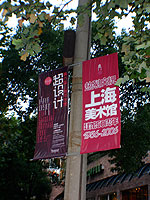
A light entry fee makes for an even stream of locals and foreigners. As with the traffic in Shanghai, no rules are naturally observed thus touching the works whilst taking photos is part of the Shanghaniese exhibition experience. The visitation path makes a knot at the first floor with mainly conceptual works of Chinese painters before climbing the five floors of stairs filled with a variety of works within visual arts.
Illusion seemed an overall important concept for Chinese artists and several works played with various effects of lights, glass and mirrors. Dazzled an installation by Wang Yahui (China), uses mirrors to project us into a perplexity of judgement. Walking into the installation – surrounding mirrors evoke an immediate interactive experience by making us an active part. Through mirrors, projected images of furniture allow us to walk and experience alternative viewpoints the kitchen from above, the bedroom on the side and the lounge in top. The projected image gives the effect of the room slowly revolving – constantly changing your position of focus and location.
   |
| Photographed using mobile :: Samsung D500 |
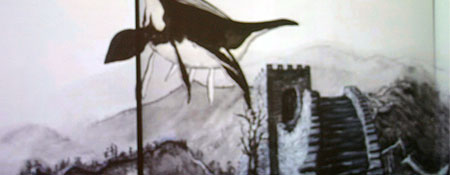
Another quite curious work of animation, The New Sutra of the Mountains and the Oceans, Qiu Anxiong (China), digs into both historical and mythical landscapes of China. Its peculiar animation technique is slightly reminiscent of a Sid Meyers’ game interlude but the narration acts as a strong subversive element leaving some audience giggling and others mesmerized in thoughts.
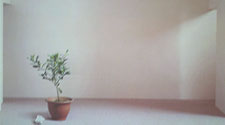
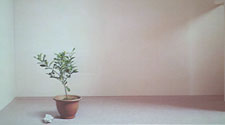
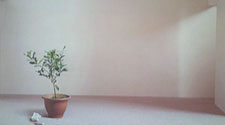
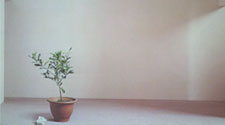
At the very top floor of the space we find a small decadent room perfect for showing Still Life In The Sun by Wang Yahui (Taiwan China). This video installation has quite a remarkable subtle play of light and shadows allowing the room to change its layout with dis/appearing windows and doors around a slow growing plant. The subtle gradients eludes our partaking in this changing room.
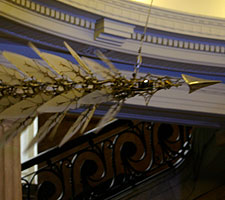
As the exhibition comes to a closing hour we wander down the stairs towards the exit. A group is already gathered gazing at the ceiling where two large electronic device creatures are suspended. In the work Urbanus ("lover of urbanity") by Choe U-Ram (Korea), a male and a female that resembles plant-like creatures quite distinctly described by size and function perform an act where the male imbibes the electrical energy discharged as photons by the female. Elongated phallic features describe the male whilst the female has a flower-like shape enclosing a light that glows bright as she opens herself to the male. As she reaches her maximum size the males motions stops and a while after the female starts closing and the game resumes with the male’s motion.
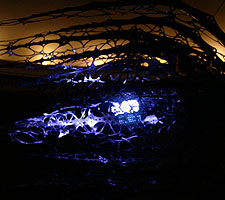
Though not sure of the number of visitors, as we exit a large LED sign counts the weight of the total number of visitors to 45448750 kg.

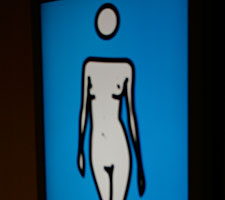
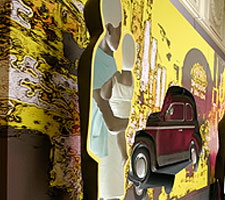
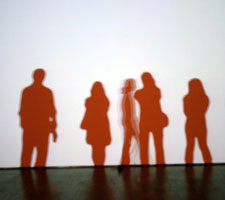
Outside there is a wonderfully described rain sculpture that didn’t seem to work during our visit. Other artists/works also worth mentioning is Julian Opie (UK), which more than anything showed his movement away from painting; In Front of The Car by Korean Lee Young playing with interesting light illusions that produces 3D paintings revolving as you move; And Untitled, Shilpa Gupta (India), which produced an interactive video installation using silhouette of both the viewer and recorded silhouette actions to explore perceptually of what is there and what is not.
The 6th biennale had a great spectre of works and it seems an important cultural attribute with the current growth of China and appropriate for Shanghai. Being a biennale, with the amount of works featured, it is difficult to explore all works in a fair manner as this would consume a lot of time but it does produce a general feel of itself as a whole. Although we didn’t see any particularly new areas explored, it gave a better image of what the contemporary Chinese artists are exploring.