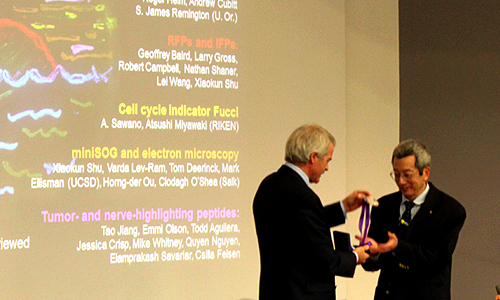
2011 UCL Prize Lecture in Clinical Science awarded to Professor Roger Y Tsien by UCL's President and Provost, Professor Malcolm Grant.
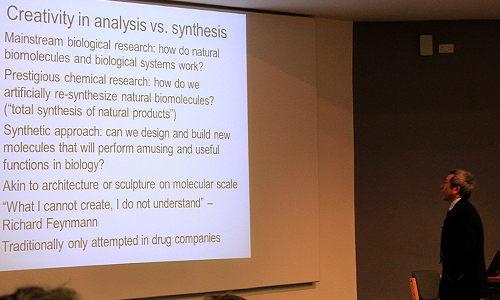
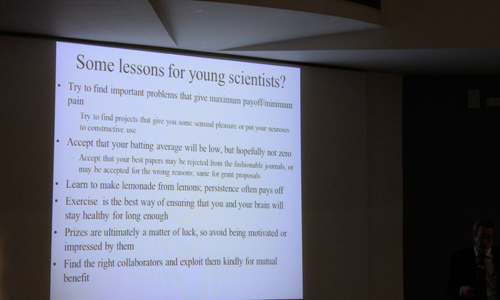
Professor Roger Y Tsien, Nobel Prize Winner in Chemistry (2008), gave his UCL prize lecture today in front of a packed lecture room on the marvels of synthetic fluorescent molecules and use of these in clinical sciences. In his modest terms, his strategy has always been: “If I am not good enough in one area, I better find an area with minimum competitors”. He pointed to the fact of being the youngest amongst three brothers, prompted the need to locate himself in more promising ecological niche.
professor roger y tsien's lecture: 'Molecules to Image Biology and Disease in Living Colour.'
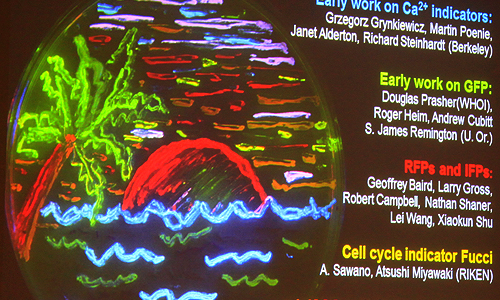
Tsien began his career in the veil of his time that was to synthetically generate natural biochemical molecules. Bored, he quickly moved outside this field and sought to literally elucidate calcium elevation during cellular processes (i.e. mitosis) using fluorescent molecules.
professor roger y tsien's lecture: 'Molecules to Image Biology and Disease in Living Colour.'
The real push in his career happened after locating and collaborating with the discoverers and first cloner of the green fluorescent proteins (GFP). By mutating its genetic sequence, Tsien and his collaborators managed to generate a fascinating variety of colours (e.g. blue, yellow, green). Expanding on the work of Russian colleagues who clone DsRed from luminescent sea corals, Tsien's group managed to expand this to a complete palette of fluorescent colours.
professor roger y tsien's lecture: 'Molecules to Image Biology and Disease in Living Colour.'
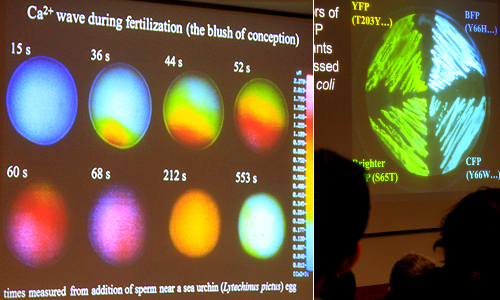
The biochemical colour palette enabled a new method of observation or as some would have it - produced the microscope of the 21st century. Tsien showed how he was able to combine his previous technique of tracking calcium elevation with multicolour fluorescent molecules to capture the movement of calcium as eggs becomes fertilised by a sperm – producing waves of colours (i.e. the 'blush of conception'). He also showed how this material could be used to highlight specific tissues and nerves that allowed surgeons to distinguish areas in difficult operations such as removing tumours whilst avoiding damaging nerves.
Tsien ended his lecture by praising the discoverer of GFP Osamu Shimomura, the first to clone this protein Douglas Prasher and the work of Martin Chalfie showing independent expression GFP across organisms. Whilst Prasher did not receive the Nobel Prize, Tsien higlighted the importance of his role and his worthiness of the prize.
professor roger y tsien's lecture: 'Molecules to Image Biology and Disease in Living Colour.'